Most software or application failures don’t happen because of poor engineering. They start much earlier, in the decisions made before development even begins.
Teams often assume that once development starts, progress is guaranteed. But in reality, unclear requirements, weak validation, and misaligned expectations quietly derail projects long before the first release.
Here’s what the data tells us:
- 70% of software projects fail to meet their original goals
- Large IT projects run 45% over budget and deliver 56% less value than expected
This isn’t a talent problem. It’s a process problem. And that process is the app discovery phase.
What Is the App Discovery Phase (Really)?
The app discovery phase is the stage where you define:
- What problem you are solving
- Who you are solving it for
- What the product should actually do
- Whether it’s technically feasible
- How success will be measured
before any development begins.
But here’s the critical distinction most teams miss:
“Discovery is not documentation. It’s decision-making.”
It’s where assumptions are challenged, risks are surfaced, and priorities are clarified.
At Nuvra, discovery is treated as a product-shaping exercise, not just a planning step, which is why it consistently leads to stronger alignment and higher delivery success rates.
The Most Overlooked Step in Discovery
If there’s one mistake that consistently leads to failure, it’s this:
“Teams don’t define the core user problem with enough clarity.”
Instead, they jump straight into:
- Features
- Screens
- Tech stacks
This creates a dangerous pattern:
- Decisions are based on assumptions
- Priorities keep shifting
- Development becomes reactive
When the problem isn’t clear, everything else becomes guesswork.
A strong discovery phase forces teams to slow down just enough to ask:
- What exact problem are we solving?
- How do users experience this today?
- What does success actually look like?
Without clear answers, even well-built software can fail.
Why the Discovery Phase Determines Project Success
A well-executed discovery phase does three things:
1. Reduces Risk Early
Instead of discovering problems during development, you identify them upfront when changes are cheaper.
2. Aligns Stakeholders
Everyone, from founders to developers, operates with the same understanding of the product.
3. Enables Faster Development Later
Ironically, slowing down in discovery speeds up delivery because there’s less rework.
The Shift in Modern Product Development
The realization that building the wrong product quickly is still failure.Today, leading teams no longer follow the old model:
Build → Launch → Fix
Instead, they operate with:
Validate → Build → Iterate
This shift is driven by:
- Faster prototyping tools
- Data-driven decision-making
- Increasing cost of failed launches
And most importantly:
7-step app discovery phase checklist
In the next section, we’ll break down a 7-step app discovery phase checklist that helps you:
- Avoid unclear requirements
- Validate ideas before investing heavily
- Scope your MVP correctly
- Plan for scalability early
- Align teams before development starts
Each step is designed to be practical, not theoretical, so you can apply it immediately.
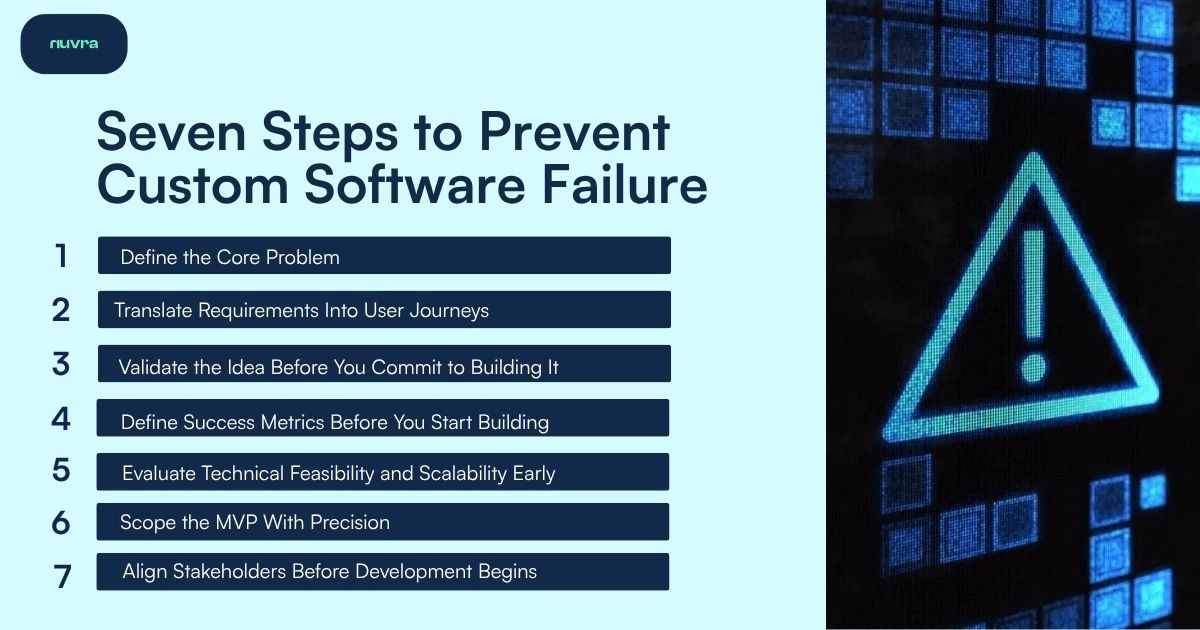
1. Define the Core Problem
Most teams begin with what they want to build. That’s the problem.
They start with ideas like a marketplace, a dashboard, or a platform, but skip the harder question: what exact problem are we solving, and for whom?
This is where many projects quietly go off track.
When the problem isn’t clearly defined, everything that follows becomes unstable. Features get added based on assumptions, priorities keep shifting, and development turns reactive instead of focused.
From experience, this is the most overlooked step in the entire discovery phase. Teams move too quickly into solutions without aligning on the problem with enough precision.
A strong discovery phase slows things down just enough to bring clarity. It forces you to articulate the problem in a way that is specific, testable, and grounded in real user context.
A simple way to think about it is:
- Who is the user?
- What exactly is frustrating them?
- In what situation does this problem occur?
When you can answer those three questions clearly, you’re no longer guessing. You’re building with intent.
And that clarity becomes the foundation for everything else, from product decisions to technical architecture.
2. Translate Requirements Into User Journeys
Once the problem is defined, teams naturally move into requirements. This is another point where things often go wrong.
Instead of structuring the product around how users experience it, requirements turn into long lists of features. On paper, it looks comprehensive. In practice, it creates confusion.
Feature lists don’t show how value is delivered. They don’t explain what matters first. And they rarely help teams make trade-offs when timelines or budgets become real constraints.
A better approach is to think in terms of user journeys.
Instead of asking, “What features do we need?”, the question becomes:
“What does the user need to do to get value from this product?”
That shift changes everything.
Now you’re mapping how a user moves from the first interaction to the first meaningful outcome. You start seeing dependencies, friction points, and unnecessary complexity much earlier.
For example, instead of listing login, dashboard, and notifications as separate requirements, you define a flow where a user signs up, completes onboarding, and achieves their first result. That’s a usable structure. That’s something a team can build around.
This is also where strong MVP thinking comes in. You’re not trying to define the full product. You’re identifying the smallest set of actions that deliver value.
Teams that get this right move faster later. Not because they build less, but because they build what matters first.
3. Validate the Idea Before You Commit to Building It
Even with a clear problem and structured journeys, there’s still one critical question left:
Does this solution actually work for real users?
This is where validation comes in, and where many teams take shortcuts.
There’s a tendency to rely on internal confidence or positive feedback from a few conversations. But validation isn’t about what users say. It’s about what they do.
If users don’t engage with a simple version of your idea, building a more polished version won’t solve the problem. It just makes the mistake more expensive.
Effective validation doesn’t require a full product. In fact, it works best when the investment is minimal.
You might test a clickable prototype, run a simple landing page, or speak directly with users about how they currently handle the problem. In some cases, teams even deliver the solution manually before building anything, just to confirm demand.
What matters is not the method, but the signal.
Are users interested enough to take action?
Do they see real value?
Are they willing to change their current behavior?
If the answer is unclear, that’s not a failure. That’s exactly what discovery is supposed to uncover.
One of the most consistent patterns in unsuccessful products is that validation was either skipped or treated as a formality. The assumption was that building more would fix the issue.
It rarely does.
At this point in the discovery phase, three things should be clear:
- The problem is specific and grounded in real user context
- The product is structured around user journeys, not features
- The idea has been tested enough to show real signals of value
If these are solid, you’re no longer operating on assumptions. You’re moving toward execution with confidence.
4. Define Success Metrics Before You Start Building
By this stage, most teams feel ready to begin development. The problem is, many still haven’t defined what success actually looks like.
This creates a subtle but serious issue.
Without clear success metrics, every team interprets progress differently. Product teams focus on features shipped, developers focus on completion, and stakeholders focus on outcomes, but none of these are aligned.
A strong discovery phase removes this ambiguity early.
Instead of saying, “We want a better onboarding experience,” you define what “better” means in measurable terms. It could be the percentage of users completing onboarding, the time it takes to reach first value, or the number of users returning after the first session.
This clarity does two things. First, it aligns everyone around a shared outcome. Second, it makes decision-making easier during development. When trade-offs appear, and they always do, you can evaluate them against a clear definition of success.
In modern product environments, this is becoming even more important. With analytics tools integrated early, teams are expected to make data-informed decisions from day one, not after launch.
If you don’t define success during discovery, you’re effectively postponing critical decisions to a much more expensive phase.
5. Evaluate Technical Feasibility and Scalability Early
One of the biggest misconceptions about the discovery phase is that it’s purely a product or business exercise. In reality, it’s equally a technical one.
When technical considerations are delayed, teams often run into issues that force them to rethink core decisions mid-development. This is where timelines slip and costs increase.
Early feasibility planning doesn’t mean over-engineering the solution. It means understanding the boundaries within which the product will operate.
This includes thinking through how the system will handle data, what integrations are required, and how the architecture might evolve as usage grows.
From experience, one of the most important roles during discovery is played by architects and senior engineers. Their input helps surface constraints early, not to slow things down, but to prevent avoidable rebuilds later.
The goal is not to design the final architecture, but to avoid decisions that won’t scale.
There are always trade-offs here. Speed versus scalability, cost versus flexibility, simplicity versus future readiness. A good discovery phase doesn’t try to eliminate these trade-offs, it makes them visible so teams can choose deliberately.
This is especially relevant today, where cloud infrastructure, AI integrations, and real-time data flows are becoming standard expectations rather than advanced features.
Skipping this step doesn’t save time. It simply shifts complexity into the development phase, where it becomes harder to manage.
6. Scope the MVP With Precision
By now, the product is clearer, validation signals exist, and technical direction is taking shape. The next step is defining the MVP.
This is where many teams unintentionally overcomplicate things.
An MVP is often misunderstood as a smaller version of the full product. In practice, it should be something much more focused.
It is the fastest way to deliver and test core value.
That distinction matters.
When teams try to include too much in the MVP, they slow down validation and increase risk. When they scope it correctly, they create a feedback loop that informs future iterations.
The key is to focus on the essential user journey identified earlier. What is the minimum set of actions a user needs to complete to experience value?
Anything beyond that can wait.
This doesn’t mean ignoring the future. It means separating what needs to be built now from what needs to be designed for later.
Strong product teams operate with this balance. They build for immediate validation while keeping an eye on scalability, not by adding features early, but by making thoughtful architectural choices.
This is also where disciplined discovery directly impacts timelines. Teams that scope MVPs well are able to deliver within predictable windows, often in the range of a few months depending on complexity, without constant rework.
7. Align Stakeholders Before Development Begins
The final step in the discovery phase is often underestimated, but it has a direct impact on execution.
Even with a well-defined problem, clear journeys, validated ideas, and scoped MVP, projects can still struggle if stakeholders are not fully aligned.
Misalignment doesn’t always show up immediately. It surfaces later as changing priorities, conflicting expectations, or repeated revisions.
This is why alignment is not just about agreement, it’s about shared understanding.
Everyone involved should be clear on:
- What is being built
- Why it matters
- What is included (and what is not)
- How success will be measured
In practice, this often involves structured discussions, walkthroughs of user journeys, and reviews of scope and assumptions.
At this stage, clarity is more valuable than speed. It’s better to resolve disagreements before development begins than to discover them halfway through the build.
From experience, when this step is rushed or skipped, teams end up revisiting the same decisions multiple times during development. That’s where delays, rework, and frustration come from.
What This Phase Really Achieves
By the end of these steps, something important has happened.
The project has moved from:
- An idea with assumptions
to:
- A clearly defined, validated, and executable plan
You’re no longer asking, “What should we build?”
You’re asking, “How do we build this efficiently?”
That shift is what prevents most of the common failure patterns in custom software projects.
At this point, a strong discovery phase ensures:
- Success is clearly defined and measurable
- Technical decisions are informed, not reactive
- The MVP is focused on real value
- Stakeholders are aligned before execution
This is what turns discovery into a strategic advantage, not just a preliminary step.
Discovery Is Where Successful Products Are Actually Built
By the time development starts, most of the important decisions have already been made.
The problem has been defined (or not).
The scope has been shaped (or bloated).
The risks have been identified (or ignored).
That’s why the application discovery phase isn’t just an early step, it’s where product success is determined.
When done right, it creates clarity across every layer of the project:
- Teams know exactly what they’re building
- Stakeholders understand trade-offs upfront
- Development moves with fewer interruptions
When rushed or skipped, the opposite happens. Teams spend months correcting assumptions that should have been addressed in weeks.
From experience, the difference is not subtle. Projects with strong discovery move faster, cost less to build, and are far more likely to deliver real business value.
And in today’s environment, where AI capabilities, cloud infrastructure, and user expectations are evolving quickly, this clarity becomes even more critical. Products are no longer static. They need to adapt, scale, and integrate continuously.
That only works when the foundation is solid.
The simplest way to approach it is this:
Don’t start with what you want to build.
Start with what needs to be true for this product to succeed.
Everything else follows from that.