A decade ago, a fast-loading, responsive website was enough to stand out. Today, it’s table stakes.
Users now expect web applications to adapt, learn, and respond intelligently, whether they’re customers navigating a SaaS dashboard, users searching through documents, or teams interacting with internal portals. Static pages and even rule-based dynamic websites struggle to meet these expectations at scale.
This shift is why AI-powered web development is no longer an “innovation experiment.” It’s becoming a core capability for businesses building serious digital products.
But here’s the reality many enterprises still miss: AI doesn’t simply make websites smarter. It changes how web systems are designed, operated, and evolved over time. In fact, over 95% of customer interactions are expected to be powered by AI, in the coming years, making personalization faster and more effective than ever.
This guide explores how web development has moved from static to dynamic, and now to intelligent, and what that means for building AI-powered web applications that actually deliver long-term value.
The Static Web Era: Informational, Predictable, Limited
Early websites functioned as digital brochures.
Content was hard-coded, updates were manual, and user interaction was minimal.
From a business perspective, static websites had clear limitations:
- No personalization
- No behavioral insight
- No ability to adapt based on user intent
They answered “What do we want to say?”—not “What does this user need right now?”
The Rise of Dynamic Web Applications
As JavaScript frameworks, APIs, and cloud infrastructure matured, websites evolved into dynamic systems.
This era introduced:
- Interactive forms and dashboards
- Real-time data rendering
- User accounts and role-based access
While dynamic web apps improved usability, they still relied heavily on predefined logic:
“If the user does X, show Y.”
That approach works, until complexity explodes.
At scale, rule-based systems become brittle, expensive to maintain, and slow to adapt. This is where AI fundamentally changes the equation.
The AI-Powered Web Era: Systems That Learn, Not Just Respond
AI-powered web development introduces a new capability: adaptation without explicit rules.
Instead of hardcoding every decision, AI-enabled web applications can:
- Learn from user behavior
- Predict intent and outcomes
- Continuously improve without full rewrites
This shift turns web apps from static products into living systems.
However, one of the biggest misconceptions enterprises still have—even in 2026—is treating AI as just another technology upgrade.
In reality, AI is an operating-model change.
When AI is bolted onto existing workflows without rethinking processes, decision ownership, and accountability, results plateau quickly. Sustained value only appears when web platforms, teams, and workflows are redesigned around AI-augmented work, not AI features.
What Is AI-Powered Web Development (In Practical Terms)?
AI-powered web development is not about adding chatbots everywhere or claiming “AI-first” branding.
At its core, it means embedding intelligence into how a web application:
- Understands users
- Makes decisions
- Optimizes performance
- Evolves over time
Practically, AI shows up across the web stack:
- Frontend: adaptive UI, personalized content, intelligent search
- Backend: recommendations, predictions, anomaly detection
- Operations: performance optimization, security monitoring, automation
Crucially, successful AI-powered web apps are designed with replaceability in mind.
Models change. Providers evolve. Regulations shift.
Web architectures that allow teams to swap models without rewriting systems are the ones that survive long-term.
How AI Transforms Web User Experience (UX) at Scale
Personalization That Goes Beyond Rules and Segments
Traditional personalization relies on segments:
- New vs returning users
- Geography
- Role-based views
AI enables behavior-driven personalization instead.
By analyzing interaction patterns in real time, AI-powered web applications can adjust:
- Content priority
- Feature visibility
- Recommendations
- Messaging tone
In SaaS platforms, this often means different users see entirely different journeys, without designers manually mapping every path. The result isn’t just better engagement. Businesses that use AI-powered personalization achieve up to 1.7× higher conversion rates and up to 28% lower customer churn, as AI helps tailor experiences to individual needs in real time.
The outcome is less friction, shorter time-to-value, and higher retention, all at scale.
Smarter Navigation and Adaptive User Flows
Navigation is one of the most underestimated drivers of user satisfaction.
AI allows web apps to:
- Predict which sections matter most to a user
- Reorder menus dynamically
- Surface shortcuts based on usage patterns
Instead of forcing users to “learn the product,” the product adapts to how people actually work.
This is especially powerful in complex systems like dashboards, admin panels, and internal tools, where traditional UX often breaks down under feature sprawl.
AI Chatbots and Conversational Interfaces (Done Right)
Customer-facing chatbots are one of the fastest ROI AI use cases, when designed correctly.
The key is augmentation, not replacement.
The most effective implementations combine:
- AI agents for routine queries
- Clear human escalation paths
- Tight integration with backend systems
This approach reduces support load, improves response times, and maintains trust—without pretending AI can handle everything autonomously.
Attempts to fully automate decision-making in regulated or high-risk environments remain overhyped and often counterproductive.
Performance and Load Optimization with AI
AI-powered web systems don’t just react to traffic, they anticipate it.
By analyzing historical patterns and real-time signals, AI can:
- Predict traffic spikes
- Allocate server resources proactively
- Optimize image delivery and API calls
This leads to faster load times, lower bounce rates, and more resilient systems during peak demand, especially critical for marketplaces, SaaS platforms, and data-heavy web apps.
AI Use Cases in Modern Web Applications (What Actually Works)
AI becomes valuable in web applications when it is applied inside real workflows, not layered on top as a novelty. The most successful AI-powered web platforms today focus on a small number of high-impact use cases, executed deeply.
Below are the AI use cases consistently delivering measurable ROI across SaaS platforms, marketplaces, portals, and internal web systems.
AI-Powered Dashboards & Admin Panels
Dashboards are where complexity quietly accumulates.
As products scale, admin panels often become:
- Feature-heavy
- Data-dense
- Difficult to navigate
AI helps by prioritizing information instead of displaying everything.
In modern AI-powered web dashboards:
- Metrics are ranked by relevance, not fixed layout
- Anomalies are flagged automatically
- Trends are summarized instead of manually interpreted
For operations, finance, or product teams, this shifts dashboards from reporting tools to decision-support systems.
This is one of the fastest-return AI investments because it directly improves how teams spend their time—without changing user-facing features.
Recommendation Engines Inside Web Platforms
Recommendation engines are no longer limited to e-commerce.
In AI-powered web applications, they are now widely used for:
- Feature suggestions in SaaS products
- Content prioritization in knowledge platforms
- Workflow recommendations in internal tools
The key difference between effective and ineffective implementations lies in scope.
High-performing systems start narrow:
- One decision
- One context
- One measurable outcome
Trying to deploy a “one-model-fits-all” recommendation layer across an entire enterprise platform is one of the most common, and costly, mistakes teams make.
Focused, domain-specific recommendation engines outperform generic models every time.
AI Search, RAG & Document Intelligence
Search is one of the most visible failure points in complex web applications.
Traditional keyword search breaks down when:
- Data grows unstructured
- Users don’t know exact terminology
- Context matters
AI-powered search, often using retrieval-augmented generation (RAG), allows users to:
- Ask natural-language questions
- Search across documents, tickets, and records
- Get contextual, summarized answers
This is especially powerful in:
- Internal knowledge portals
- Compliance-heavy industries
- Customer-facing help centers
When implemented well, AI search reduces support load, onboarding time, and internal friction almost immediately.
Predictive Analytics Embedded in Web Apps
Predictive analytics delivers the most value when it is embedded into decisions, not surfaced as standalone charts.
In AI-powered web platforms, predictive models are commonly used to:
- Forecast demand or usage
- Identify churn risk
- Predict operational bottlenecks
- Flag financial anomalies
The most important design principle here is measurement.
High-performing teams evaluate success using business KPIs, not model accuracy:
- Did decisions improve?
- Did costs decrease?
- Did outcomes become more predictable?
Accuracy without business impact is noise.
AI-Assisted Forms, Validation & Data Entry
Forms are unavoidable, and often painful.
AI reduces friction by:
- Auto-completing fields
- Detecting inconsistencies in real time
- Validating data against historical patterns
In finance, operations, and enterprise onboarding flows, this dramatically reduces:
- Manual review time
- Error rates
- Drop-offs
These improvements are subtle but compound quickly at scale, making this one of the quietest high-ROI AI use cases in web development.
Where Enterprises Get Fast ROI and Where They Don’t
Based on real-world implementations, ROI patterns are becoming clear.
Fastest ROI AI use cases in web applications:
- Customer support automation (AI agents + human escalation)
- Finance & operations workflows (invoicing, reconciliation, fraud detection)
- Software productivity tools (testing, refactoring, internal tooling)
Overhyped or high-risk areas:
- Fully autonomous decision-making in regulated environments
- Generic enterprise-wide AI platforms
- Attempts to replace entire job functions instead of augmenting them
AI works best when it supports humans, not when it tries to remove them from the loop entirely.
What This Means for Web Product Teams
AI-powered web development is not about chasing features.
It’s about redesigning how work gets done inside digital products.
Teams that succeed:
- Start with clear workflows
- Apply AI narrowly and deeply
- Measure business outcomes, not technical novelty
In the next section, we’ll go deeper into how AI fits into the web development lifecycle itself, from discovery and design to testing, deployment, and iteration—and how this is already reshaping development teams and timelines.
AI in Web Development: Beyond User Experience
While user experience is where AI is most visible, the biggest long-term gains often happen behind the scenes. AI is increasingly shaping how web applications are created, secured, optimized, and maintained, often with less fanfare, but far greater operational impact.
This is also where many enterprises underestimate the scope of change required.
AI doesn’t just improve outputs. It changes how systems are operated.
AI for Content Creation & Content Operations
AI-assisted content creation has moved well beyond marketing copy.
In modern web platforms, AI is now used to:
- Generate knowledge-base articles
- Summarize long-form documents
- Create product descriptions and metadata
- Maintain content freshness across large platforms
When used responsibly, AI improves consistency and speed, especially in content-heavy systems like:
- SaaS help centers
- Learning platforms
- Marketplaces
- Documentation portals
However, the trade-off is governance.
Without clear ownership, review workflows, and brand controls, AI-generated content can:
- Drift from business intent
- Introduce inaccuracies
- Erode trust over time
The teams seeing real value treat AI as a content accelerator, not an autonomous author.
AI-Driven Web Security & Threat Detection
As web applications become more complex, traditional security approaches struggle to keep up.
AI adds a layer of continuous intelligence by:
- Detecting unusual behavior patterns
- Identifying potential fraud in real time
- Flagging anomalies before breaches escalate
In practice, AI-powered security systems monitor:
- Login behavior
- API usage patterns
- Transaction anomalies
- Data access irregularities
What matters most here is designing security as part of the system, not bolting it on later.
Successful AI-powered web platforms adopt:
- Zero-trust access models
- Clear data residency rules
- Strong data leakage controls
Security failures are rarely due to missing tools—they’re due to unclear accountability and fragmented system ownership.
Predictive Monitoring & Maintenance
One of AI’s most underrated benefits in web development is predictive maintenance.
Instead of reacting to outages or slowdowns, AI systems can:
- Forecast performance degradation
- Identify fragile components
- Recommend fixes before users notice issues
This is particularly valuable for:
- High-traffic platforms
- Enterprise dashboards
- Mission-critical internal tools
The result isn’t just better uptime—it’s predictability.
Teams spend less time firefighting and more time improving the product.
Rethinking Success Metrics: Business Outcomes Over Model Accuracy
One of the most common mistakes in AI-powered web initiatives is measuring the wrong things.
Model accuracy, latency, and benchmarks matter—but they are secondary.
Long-term success is determined by:
- Reduced operational cost
- Faster decision-making
- Lower error rates
- Improved user retention
- Higher team productivity
AI initiatives that aren’t tied to clear business KPIs often look impressive technically—while quietly failing commercially.
This is why measurement strategy should be defined before model selection, not after deployment.
Why AI Forces a Shift in Operating Models
The biggest misconception enterprises still have about AI adoption is assuming it behaves like a typical software upgrade.
It doesn’t.
AI changes:
- Who makes decisions
- How work is reviewed
- Where accountability lives
- How systems evolve over time
Without redesigning workflows, incentives, and ownership, AI-powered web systems quickly hit a ceiling.
This is why many organizations are being forced to rethink team structures—introducing roles like:
- AI product leadership
- Data engineering at scale
- AI governance and compliance specialists
- Human–AI workflow designers
Data engineering, in particular, remains the single biggest bottleneck globally. Without reliable, domain-specific data pipelines, even the best models underperform.
What This Means for Web Development Teams
AI doesn’t reduce the need for strong engineering teams, it raises the bar.
Over the next two years:
- Developers will shift from writing code to supervising systems
- Architecture, specifications, and testing will matter more than syntax
- Smaller teams will ship faster—but senior engineers will carry more responsibility
- Development cycles will compress, while review, security, and governance expand
Web development is becoming less about producing features, and more about designing systems that learn safely, scale reliably, and evolve responsibly.
How AI Fits into the Web Development Lifecycle
AI does not sit at the end of the web development process.
When implemented correctly, it influences every stage of the lifecycle, from early discovery to post-launch iteration.
Teams that treat AI as a final feature often struggle to scale or maintain it. Teams that design for AI from day one build more resilient and adaptable web systems.
Discovery and Product Planning
AI-powered web development starts long before any model is selected.
During discovery, the most important questions are not technical:
- Which decisions need better data support?
- Which workflows are slow, manual, or error-prone?
- Where do users struggle to find answers or take action?
Strong AI-driven products are anchored in clear problem definitions, not abstract use cases.
At this stage, successful teams:
- Identify workflows where AI can augment human decisions
- Define business KPIs that matter more than model metrics
- Assess data availability and quality early
This is also where many AI initiatives fail. If data ownership is unclear or domain knowledge is fragmented, no model choice will fix it later.
Design and User Experience Decisions
AI has a direct impact on how web experiences should be designed.
Traditional UX assumes predictable behavior.
AI-driven UX must assume variability.
Design teams now need to account for:
- Dynamic content that changes based on behavior
- Interfaces that adapt over time
- Confidence indicators and explanations for AI-driven outputs
The goal is not to hide AI decisions, but to make them understandable.
Well-designed AI-powered web apps:
- Show users why something is recommended
- Allow users to correct or influence outcomes
- Build trust through transparency
This is where human-AI workflow design becomes critical. Users must feel supported, not overridden.
Frontend and Backend Development
From a development perspective, AI introduces new architectural considerations.
On the frontend:
- Interfaces must handle changing data states gracefully
- Components need to support personalization and prediction
- Performance must remain consistent despite dynamic behavior
On the backend:
- AI services are typically exposed through APIs
- Systems must be designed to swap models without major rewrites
- Logging, monitoring, and fallback mechanisms are essential
One of the most important architectural decisions is decoupling AI logic from core application logic. This allows teams to iterate on models without destabilizing the entire web platform.
Build versus buy decisions also matter here. Flexibility almost always wins over short-term convenience.
Testing, QA, and Validation
AI changes how testing works.
Traditional QA focuses on deterministic outcomes.
AI systems are probabilistic by nature.
Effective testing strategies include:
- Validating outputs across edge cases
- Testing human override and escalation paths
- Monitoring drift in behavior over time
- Ensuring explainability where required
Security and compliance testing also expand at this stage, especially for applications handling sensitive data.
This is where governance becomes part of engineering, not a separate process.
Deployment and Continuous Improvement
Once deployed, AI-powered web applications should never be considered finished.
Post-launch, AI systems require:
- Continuous monitoring of performance and outcomes
- Regular model updates and retraining
- Ongoing review of business impact
The most mature teams treat deployment as the beginning of learning, not the end of delivery.
Feedback loops between users, data, and product decisions become tighter, allowing web platforms to improve without constant rewrites.
What This Means for Teams and Timelines
AI is reshaping how web products are built and maintained.
Over the next two years:
- Development cycles will become shorter
- Small, senior-heavy teams will deliver more impact
- Code writing will matter less than system supervision
- Review, security, and governance effort will increase
AI does not remove complexity.
It shifts where complexity lives.
Teams that adapt their lifecycle, roles, and expectations will move faster with fewer surprises.
Challenges and Trade-Offs of AI-Powered Web Development
AI-powered web development unlocks clear advantages, but it also introduces new constraints that teams must plan for early. Most failures do not come from poor models. They come from underestimated trade-offs.
Understanding these challenges upfront is what separates scalable AI web platforms from short-lived experiments.
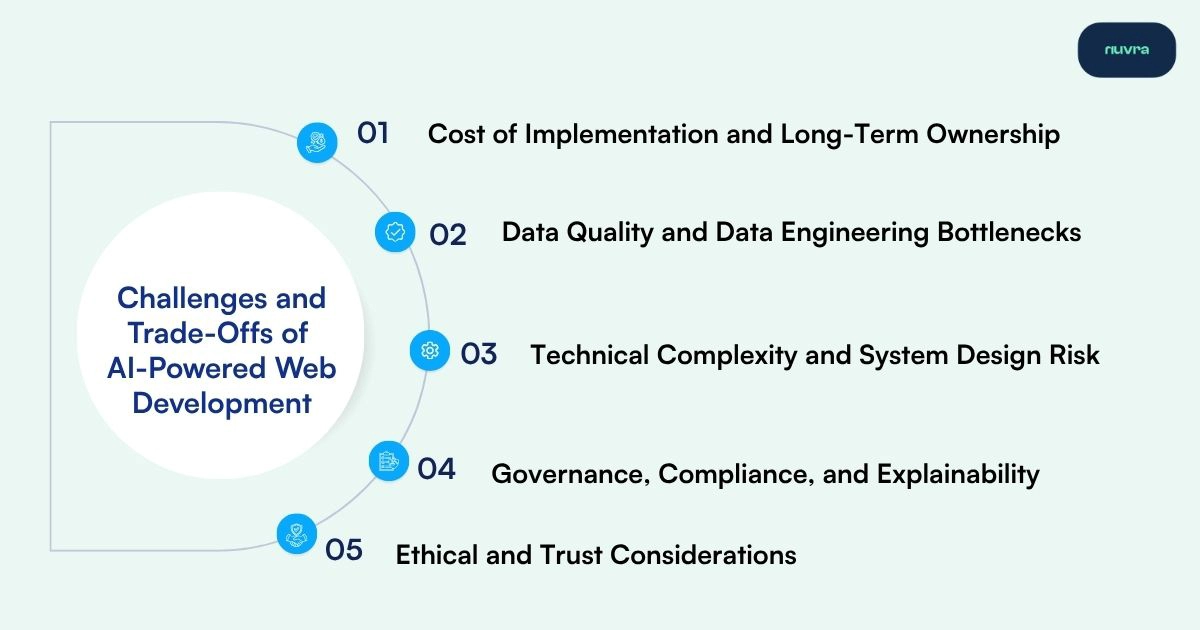
Cost of Implementation and Long-Term Ownership
AI is often marketed as a productivity shortcut. In practice, it is an investment with ongoing ownership costs.
Common cost drivers include:
- Data infrastructure and pipelines
- Model hosting, inference, and monitoring
- Security, compliance, and audits
- Ongoing iteration and retraining
While some AI use cases deliver fast ROI, others require a longer runway before value compounds. Teams that expect immediate returns across all features often abandon AI initiatives too early or cut corners that cause problems later.
The key trade-off is speed versus sustainability. Faster implementations often sacrifice flexibility and long-term control.
Data Quality and Data Engineering Bottlenecks
Data remains the single biggest constraint in AI-powered web systems.
Without:
- Clear data ownership
- Reliable real-time access
- Domain-specific data models
Even the best AI models underperform. Many enterprises underestimate how much effort data engineering requires at scale. In fact, 69% of companies say poor data limits their ability to make informed decisions, and 45% report that fragmented, unstructured data is the biggest barrier to AI success.
This is why data engineering continues to be the number one global bottleneck for AI adoption.
Technical Complexity and System Design Risk
AI introduces probabilistic behavior into systems that were previously deterministic.
This creates new risks:
- Unpredictable edge cases
- Model drift over time
- Harder-to-debug failures
Poorly designed architectures tightly couple AI logic with core application logic. When models change, entire systems break.
Resilient AI-powered web platforms are built with:
- Decoupled AI services
- Clear fallback mechanisms
- Strong observability and logging
The trade-off here is initial simplicity versus long-term adaptability.
Governance, Compliance, and Explainability
As AI becomes embedded into decision-making workflows, governance is no longer optional.
Key challenges include:
- Model versioning and auditability
- Explainability for regulated decisions
- Bias detection and mitigation
- Data residency and privacy controls
Fully autonomous decision-making in regulated environments remains overhyped for a reason. In most enterprise web applications, AI must support decisions, not make them in isolation.
Governance should be designed into the system, not layered on after launch.
Ethical and Trust Considerations
User trust is fragile.
AI-powered web applications that:
- Provide no explanations
- Offer no override mechanisms
- Appear unpredictable
Quickly lose credibility.
Ethical AI is not about abstract principles. It is about clear accountability. Users need to know when AI is involved, how outputs are generated, and what options they have if something feels wrong.
Transparency builds adoption. Opaqueness blocks it.
The Real Trade-Off Enterprises Must Accept
AI does not eliminate complexity.
It relocates complexity.
Instead of managing static rules, teams manage:
- Data pipelines
- Model behavior
- Governance frameworks
- Human-AI collaboration
Enterprises that accept this shift early build stronger systems. Those that resist it often struggle with fragile implementations that cannot scale.
Will AI Replace Web Developers? A Practical Reality Check
AI will not replace web developers. It will change what high-value development work looks like.
What is already happening:
- Developers spend less time writing boilerplate code
- More time is spent on architecture, specifications, and system design
- Reviews, testing, and security matter more than syntax
AI tools accelerate delivery, but they still require human judgment, context, and accountability. Teams that understand this shift are shipping faster with smaller, more senior groups.
The future is not fewer developers.
It is developers doing more meaningful work.
The Future of AI-Powered Web Applications
AI-powered web development is moving beyond experimentation and into infrastructure-level adoption. Over the next few years, several clear patterns are emerging.
Autonomous but Supervised Web Platforms
Web applications will increasingly manage parts of themselves:
- Automatically optimizing performance
- Adjusting interfaces based on usage
- Identifying issues before users report them
These systems will not be fully autonomous. Human oversight, approval flows, and rollback mechanisms will remain essential, especially in enterprise environments.
Natural Language as a Primary Interface
Natural language processing is changing how users interact with web applications.
Instead of navigating deep menus, users increasingly:
- Ask questions
- Describe outcomes
- Search conversationally
This is especially impactful in dashboards, analytics platforms, and document-heavy systems where traditional navigation slows users down.
AI-Native Web Products
The most successful products will not add AI later.
They will be designed with AI as a core capability:
- Data pipelines built from day one
- Feedback loops embedded into workflows
- Interfaces designed for adaptation
AI-native web applications evolve continuously without constant redesigns.
Why Businesses Partner with AI-Focused Web Development Teams
AI-powered web development requires more than technical execution.
Many businesses partner externally because they need:
- Experience translating business goals into AI-enabled workflows
- Teams that understand data, architecture, and delivery trade-offs
- Faster execution without internal experimentation risk
The real value of an experienced partner is not tools.
It is knowing what not to build, when to simplify, and where AI genuinely adds leverage.
From Static Websites to Learning Systems
Web development has moved through three clear phases:
- Static websites that informed
- Dynamic web applications that interacted
- AI-powered systems that adapt and learn
AI is not just enhancing web experiences. It is reshaping how products are built, operated, and improved over time.
Enterprises that treat AI as a feature will see limited gains. Those that redesign workflows, accountability, and systems around AI-augmented work will build platforms that scale with confidence.
The future of the web belongs to systems that understand users, support teams, and improve continuously.