Most apps don’t fail because of poor features. They fail because users don’t come back.
Industry data consistently shows that 70–80% of users drop off within the first few days after installing an app. The real problem isn’t acquisition, it’s retention.
Here’s the simplest way to think about this:
“Acquisition gets you installs. Retention builds a business.”
If users don’t return, your CAC increases, your growth stalls, and your product never compounds in value.
At Nuvra, this is something we see often, especially with startups launching MVPs. Founders focus heavily on building features, but user momentum is rarely designed intentionally.
And that’s the shift this blog is about.
What Is App User Retention (And What Actually Matters)
App user retention is often reduced to a set of metrics, Day 1, Day 7, or Day 30 retention rates. While these are useful indicators, they only tell you what is happening, not why it is happening.
In practice, retention is better understood as a reflection of how consistently users find value in your product over time. If users return, it means the product has earned a place in their routine. If they don’t, it usually signals that either the value wasn’t clear, wasn’t immediate, or wasn’t strong enough to compete with alternatives.
This is where many teams misinterpret retention. They focus on improving engagement metrics, more sessions, more clicks, more features, without addressing the underlying question:
Are users actually achieving something meaningful when they use the app?
Retention improves when users can repeatedly complete a valuable action with minimal effort. This is why high-retention products tend to revolve around a small number of core actions that are easy to perform, easy to understand, and consistently reinforced.
Why Users Churn: The Real Reasons Behind Early Drop-Off
Most apps lose users very early, often within the first few interactions. While this is usually attributed to “low engagement,” the underlying causes are more specific and more structural.
1. Lack of Immediate Value
The most common reason users abandon an app is simple: they do not experience clear value quickly enough.
If the first session feels slow, confusing, or inconsequential, the app becomes easy to ignore. Users rarely give products multiple chances to prove themselves. In many cases, the absence of early progress creates the perception that the app is unnecessary.
This is particularly visible in MVP-stage products, where functionality exists but value is not clearly surfaced. Without a strong first outcome, even well-built apps fail to create retention.
2. Overloaded or Misguided Onboarding
Many onboarding flows attempt to explain everything the product can do. In doing so, they delay the moment where users actually experience what the product does.
Effective onboarding is not about education, it is about acceleration.
Users should be guided toward a meaningful outcome as quickly as possible. Every additional step, explanation, or permission request increases friction and reduces the likelihood of reaching that moment.
Products that retain users tend to remove unnecessary steps and focus on helping users achieve their first success, rather than understand the full system.
3. Weak Core Loop Design
Retention is not driven by features; it is driven by loops.
If an app does not clearly reinforce the action users are supposed to return for, engagement becomes inconsistent. Users may explore once, but they have no reason to come back.
Strong products are designed around a repeatable cycle:
- A clear action
- A visible outcome
- A reason to return
When this loop is missing or unclear, users drift away, not because the app is bad, but because it does not fit into a repeatable behavior.
4. Friction in Key Interactions
Even when value exists, friction can prevent users from reaching it consistently.
This friction can come from:
- Slow performance
- Confusing navigation
- Too many steps to complete a task
- Lack of feedback after actions
Over time, even small inefficiencies compound. Users begin to associate the app with effort rather than usefulness, which gradually reduces return frequency.
This is why successful apps tend to optimize a few critical interactions extremely well, rather than expanding feature sets. The goal is not to offer more, it is to make the core experience effortless.
5. Lack of Data-Driven Iteration
Many retention strategies fail because they are based on assumptions rather than real user behavior.
Without behavioral analytics, teams cannot see:
- Where users drop off
- Which actions correlate with retention
- Which flows create friction
As a result, improvements become guesswork.
In contrast, teams that actively analyze user behavior can refine their product continuously. They identify patterns, remove friction points, and reinforce the actions that lead to repeat usage.
Retention, in this sense, is not a one-time effort. It is an ongoing process of observing, learning, and iterating.
A More Useful Way to Think About Retention
Instead of treating retention as a metric to optimize, it is more useful to think of it as a system that needs to be designed.
At its core, retention depends on three conditions:
- Users reach value quickly
- The core action is easy to repeat
- The experience improves or remains relevant over time
If any of these break, retention declines.
This is also where emerging technologies, especially AI, are beginning to play a role. By adapting experiences, surfacing relevant actions, and reducing friction dynamically, products can help users reach value faster and maintain engagement more consistently.
The User Momentum Framework: How Retention Actually Builds Over Time
Retention doesn’t happen in a single moment. It builds gradually, as users move from initial interaction to repeated usage and, eventually, dependency.
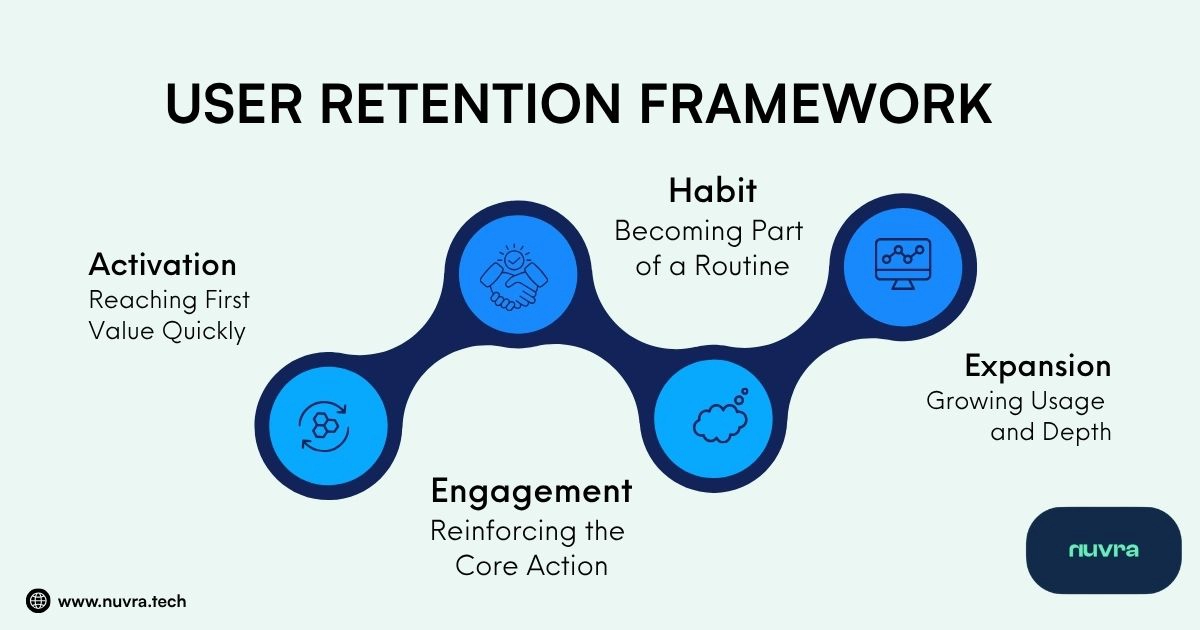
A useful way to understand this is through what we call the User Momentum Framework:
Activation → Engagement → Habit → Expansion
Each stage represents a shift in how the user perceives your product. Most apps fail not because they lack features, but because users never move cleanly from one stage to the next.
1. Activation: Reaching First Value Quickly
Activation is the point where a user experiences meaningful value for the first time.
This is not when they sign up or complete onboarding. It is when they achieve something that makes the app feel useful.
In many products, this stage is where the largest drop-off happens. Users enter with curiosity, but if they do not experience progress early, the product becomes forgettable.
The key here is not to explain the product, it is to help users accomplish something tangible as quickly as possible.
This is why effective onboarding is less about feature walkthroughs and more about guiding users toward a single, meaningful outcome. Once users see value, their willingness to continue increases significantly.
2. Engagement: Reinforcing the Core Action
Once users experience initial value, the next challenge is getting them to repeat it.
Engagement is often misunderstood as “more activity,” but in practice, it is about reinforcing the one action that defines your product’s value.
Strong products do not try to make users do many things. Instead, they make it easy, and worthwhile, to repeat the same meaningful action.
This requires:
- Clear and simple flows
- Fast, reliable performance
- Immediate feedback after actions
At this stage, design decisions matter more than feature expansion. The goal is to remove friction and make the core interaction feel natural and repeatable.
3. Habit: Becoming Part of a Routine
Habit formation begins when users no longer need to be prompted to return. The product becomes part of their workflow or daily behavior.
This transition happens when:
- The value is consistent
- The effort required is low
- The outcome remains relevant over time
Products that reach this stage tend to simplify rather than expand. They focus on making the experience predictable and efficient, so users can rely on it without thinking.
It is also where subtle reinforcements, such as reminders, progress indicators, or personalized cues, begin to play a role. When done correctly, these elements support behavior without feeling intrusive.
4. Expansion: Growing Usage and Depth
Once a habit is formed, retention becomes more stable. At this stage, the focus shifts from keeping users to deepening their engagement.
Expansion can take different forms:
- Users adopt additional features
- Usage frequency increases
- The product becomes more integrated into workflows
However, expansion only works when it builds on an already strong core experience. Introducing new features too early, or without clear relevance, often disrupts the momentum instead of strengthening it.
Where Most Apps Break the Momentum
In most cases, retention issues can be traced back to a break in this progression:
- Users never reach activation because value is delayed
- Engagement is weak because the core action is unclear
- Habits don’t form because the experience is inconsistent
- Expansion fails because the foundation is not strong
What’s important here is that retention is not solved by a single tactic. It is the result of designing each stage intentionally and ensuring smooth transitions between them.
If there is one way to simplify retention strategy, it is this:
Focus less on adding features and more on strengthening the path from first value to repeated value.
Apps that succeed long-term are rarely the ones with the most functionality. They are the ones that make a few critical interactions work exceptionally well, and then build around them.
9 Proven Strategies to Increase App User Retention
1. Reduce Time-to-Value Aggressively
Users should reach a meaningful outcome within their first session.
- Remove unnecessary steps before the first result
- Delay permissions, sign-ups, or complexity until after value is shown
- Design flows that prioritize doing over understanding
If users don’t feel progress quickly, they rarely return.
2. Design Onboarding Around Outcomes, Not Features
Onboarding should guide users to their first success, not explain the product.
- Focus on one core action instead of multiple features
- Use guided flows instead of static walkthroughs
- Keep cognitive load low, every extra step reduces completion
Good onboarding accelerates value; it doesn’t introduce the system.
3. Reinforce the Core Action Consistently
Retention improves when users clearly understand what to return for.
- Identify the single most valuable action in your app
- Make it easily accessible from the main interface
- Reinforce it through UI, prompts, and feedback
Apps that retain users well usually optimize a few key interactions, not many.
4. Minimize Friction in Repeat Usage
Even small inefficiencies can reduce long-term engagement.
- Reduce steps required to complete common tasks
- Ensure fast load times and responsive interactions
- Provide clear feedback after every action
Over time, users stay with products that feel effortless.
5. Use Behavioral Data to Guide Decisions
Retention cannot be improved without understanding real usage patterns.
- Track where users drop off in key flows
- Identify actions that correlate with repeat usage
- Continuously refine based on observed behavior
Without data, retention strategies rely on assumptions rather than evidence.
6. Build Feedback Loops That Show Progress
Users are more likely to return when they can see tangible outcomes.
- Highlight progress, completion, or improvements
- Use subtle indicators (status, history, achievements)
- Reinforce the impact of user actions
A sense of progress strengthens both engagement and habit formation.
7. Introduce Personalization to Reduce Effort
As usage grows, the product should adapt to the user.
- Surface relevant actions or content based on behavior
- Reduce decision fatigue through smart defaults
- Adjust flows to match user intent over time
Personalization, when done well, makes the experience feel faster and more relevant.
8. Use Notifications With Intent, Not Frequency
Notifications should bring users back to value not just back to the app.
- Trigger messages based on meaningful events or inactivity
- Avoid generic or repetitive reminders
- Focus on relevance rather than volume
Poorly designed notifications accelerate churn instead of improving retention.
9. Expand Only After the Core Experience Is Strong
Adding features too early often dilutes retention instead of improving it.
- Strengthen the primary use case before introducing new ones
- Ensure new features clearly connect to existing behavior
- Avoid expanding complexity without reinforcing value
Sustainable retention comes from depth, not breadth.
Designing Retention That Compounds Over Time
Improving retention is rarely about adding more features or increasing engagement artificially. It comes down to how effectively a product helps users reach and repeat meaningful outcomes.
Across most apps, the pattern is consistent. Users drop off when value is delayed, when flows feel complicated, or when the product fails to establish a clear reason to return. On the other hand, products that retain users well tend to simplify aggressively. They focus on a small set of core interactions and make those interactions fast, intuitive, and reliable.
From a strategic perspective, retention should be treated as a system rather than a metric. It begins with helping users reach value quickly, continues with reinforcing the core action, and strengthens as the product becomes part of a routine. Over time, personalization and data-driven improvements ensure that the experience remains relevant without increasing complexity.
For teams building or scaling apps, the direction is clear:
focus less on expanding functionality and more on strengthening the path from first value to repeated value.
That is where real growth compounds.