As process automation becomes more common, many organizations rush into tools before learning how to automate processes strategically. The challenge is that not every inefficient workflow should be automated. Some processes need redesign, while others are ideal candidates for automation. Understanding how to fix internal processes first can help businesses identify hidden inefficiencies, avoid automating dysfunction, and focus on the workflows that deliver the greatest operational impact.
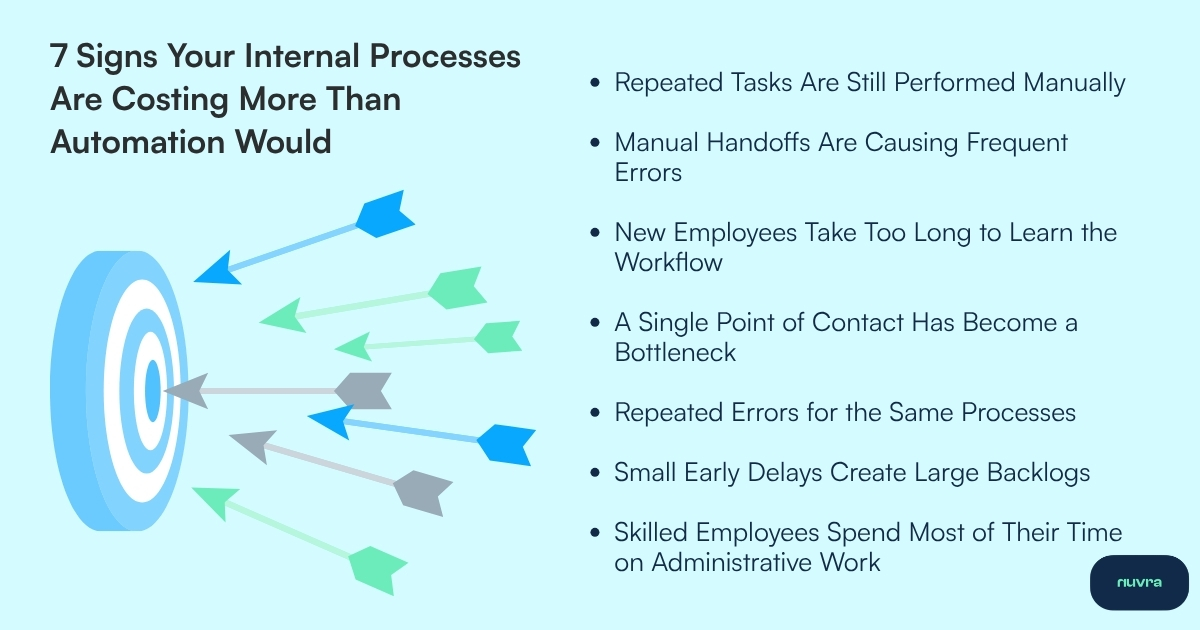
7 Signs Your Internal Processes Are Costing More Than Automation Would
1. Repeated Tasks Are Still Performed Manually
When employees repeatedly make the same decisions using the same information, the process may be ready for automation. Rule-based tasks rarely benefit from human involvement and often consume valuable time that could be spent elsewhere. If employees can accurately predict the outcome before starting the task, there is a good chance the workflow follows a pattern that can be standardized and automated.
2. Manual Handoffs Are Causing Frequent Errors
Many workflow mistakes occur when information moves between people, teams, or systems. If errors consistently appear during handoffs, the issue may be the process itself rather than the people involved. Missed updates, duplicated data, and communication gaps often become more frequent as the number of handoffs increases.
3. New Employees Take Too Long to Learn the Workflow
Long onboarding periods often indicate that a workflow has become overly dependent on undocumented knowledge. While training is necessary, complex processes can create unnecessary delays and make scaling more difficult. In many cases, businesses trying to understand how to fix internal processes discover that critical workflow knowledge exists only in the heads of a few experienced employees.
4. A Single Point of Contact Has Become a Bottleneck
If work pauses every time a specific employee is unavailable, the process carries unnecessary operational risk. Strong workflows should be able to continue without relying on one individual. This issue becomes even more visible during leave periods, role changes, or unexpected absences.
5. Repeated Errors for the Same Processes
When the same mistakes continue appearing in the same workflow, the problem is often systemic. Identifying and addressing these recurring issues is an important step in determining how to fix internal processes before introducing automation. Without addressing the root cause, teams often spend more time correcting mistakes than preventing them.
6. Small Early Delays Create Large Backlogs
Minor delays in an upstream task can quickly create bottlenecks across multiple teams. Over time, these delays compound, increasing costs and reducing overall efficiency. Organizations exploring how to automate processes often discover that a single delayed approval or manual review step is responsible for a disproportionate amount of downstream disruption.
7. Skilled Employees Spend Most of Their Time on Administrative Work
Highly skilled employees create the most value when they focus on strategic work. When much of their day is spent on repetitive administrative tasks, organizations incur a hidden opportunity cost. Over time, this can also affect employee engagement, as talented staff spend less time applying the expertise they were hired for.
How to Fix Internal Processes Before Automating Them
Not every inefficient workflow should be automated. If a process is fundamentally broken, automation simply makes the problem happen faster.
A useful test is to examine each decision point in the workflow. If every decision can be documented using a clear rule, the process is often a strong candidate for automation. If outcomes depend heavily on judgment, exceptions, or interpretation, the workflow usually needs redesign first. Understanding how to fix internal processes before investing in technology can prevent expensive mistakes later.
The Hidden Costs of Manual Workflows
Manual processes create costs that rarely appear on a budget sheet. Teams spend time correcting errors, managing delays, and coordinating work that could often be handled automatically.
There is also the opportunity cost of skilled employees performing repetitive work. In some cases, these workflows contribute to employee frustration and turnover. The cost of replacing experienced employees can easily exceed the investment required to automate the workflow causing the problem.
Why Companies Delay Automation Even When the Benefits Are Clear
Many organizations continue operating inefficient workflows because processes still function well enough to avoid a crisis. Familiarity creates comfort, even when inefficiencies are obvious.
Sunk cost thinking also plays a role. Years of training, documentation, and established habits can make change feel expensive before the numbers are even evaluated. In other cases, the person responsible for a process may be the person most affected by automating it, creating resistance that has little to do with technology itself.
How to Automate Processes That Deliver Meaningful ROI
The best automation opportunities typically share three characteristics: high volume, low variability, and expensive errors. These are the workflows where automation can often deliver the fastest returns.
When evaluating how to automate processes, businesses should calculate the full cost of the existing workflow, including oversight, corrections, delays, and administrative effort. Measuring labor hours alone rarely tells the complete story.
Before implementation, establish a baseline. Without a clear understanding of current performance, it becomes difficult to measure the true impact of automation. Successful automation projects focus on measurable improvements rather than assumptions.
Understanding how to fix internal processes is often the first step toward improving efficiency, reducing errors, and eliminating costly bottlenecks. Once the right workflows have been identified, learning how to automate processes becomes far more effective because you’re improving a strong foundation rather than accelerating a flawed one. Organizations looking to evaluate automation opportunities and build scalable workflows can benefit from working with experienced partners like Nuvra to identify the highest-impact improvements.