According to the latest digital transformation statistics, organizations are investing more than ever in technology, yet investment alone is no longer a reliable predictor of business success. The organizations seeing the strongest results are often not the ones spending the most, but the ones improving decision-making, adapting processes, and embedding change into day-to-day operations. Understanding which trends, challenges, and outcomes matter most can help leaders evaluate transformation efforts more effectively in 2026 and beyond.
The Digital Transformation Trend That Matters Most in 2026
One of the clearest trends emerging from recent digital transformation statistics is that technology adoption is no longer the primary challenge. Most organizations are already investing in new tech, yet transformation success rates remain relatively low. This suggests that competitive advantage is increasingly determined by execution rather than technology itself.
The most valuable digital transformation statistics today are not simply measuring investment levels or adoption rates. Instead, they highlight the importance of business ownership, workforce readiness, organizational alignment, and the ability to turn technology investments into measurable outcomes.
Digital Transformation Return on Investment
- 63% of organizations reported improved performance from digital transformation efforts in the previous two years.
- 56% of CEOs say digital improvements have increased their revenue
- 29% of businesses reported at least an 11% improvement in performance or profits from data and analytics investments.
- ESG goals are a technology priority for 48% of organizations.
- 27% of businesses achieved similar gains through cloud and as-a-service investments.
- Furthermore, 26% of businesses achieved it through AI and automation investments.
- 3 out of 4 organizations report their most advanced GenAI initiative is meeting or exceeding ROI expectations.
- Improved operational efficiency is the leading reported benefit of digital transformation, cited by 40% of executives.
- 36% of executives identify faster time-to-market as a key benefit of digital transformation.
- 35% say digital transformation helps meet customer expectations more effectively.
- Organizations using holistic technology evaluation frameworks are 20% more likely to achieve meaningful transformation outcomes.
- Organizations that fail to create a clear change narrative are 3.1 times less likely to succeed in digital transformation initiatives.
- Nearly 3 out of every 4 respondents in a Deloitte study reported that their most advanced GenAI initiative is exceeding their ROI expectations.
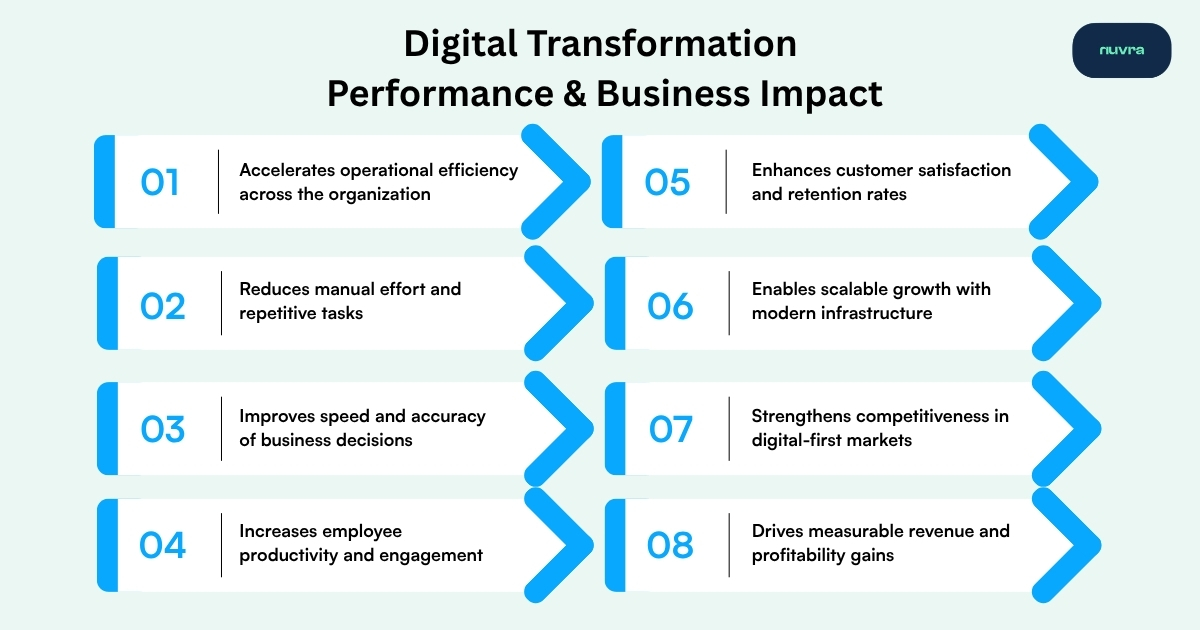
Digital Transformation Performance & Business Impact
- 90% of organizations are currently undergoing some form of digital transformation
- Being digitally savvy has become a workplace necessity, according to 93% of workers.
- Over 88% of companies are regularly using AI in at least one business function.
- Cloud adoption has reached mainstream status, with Gartner predicting 90% of organizations to adopt hybrid cloud by 2027
- Big data and analytics capabilities are a key component when it comes to business success. The big data industry is forecasted to grow to $343 Billion by 2026.
- Enterprise IoT adoption continues to grow, as 74% of organizations have implemented connected device monitoring systems to improve maintenance and operational performance.
- For 68% of organizations, operational modernization remains a primary driver behind digital transformation efforts.
- Almost 60% of companies already using OKR reported incorporating them into their change or transformation strategies.
Digital Transformation Infrastructure
- Over 50% of enterprise-critical data is generated and processed outside of the company’s own data center or cloud.
- 21% of organizations report that sensitive data creates major obstacles to digital transformation.
- 46% of organizations admit their technology teams lack sufficient organization and oversight to support transformation effectively.
- 69% of technology leaders believe they need to do a better job explaining emerging technologies to boards.
- 54% of employees feel unprepared for changes introduced by new technologies.
- 47% of executives believe fewer than half of employees have embraced transformation initiatives.
- 30% of executives cite workforce mindset and culture as a transformation barrier.
- 36% of organizations report having a risk-averse culture that slows transformation progress.
- Only 18% of executives believe their organizations are resilient enough to handle setbacks effectively.
- 45% of organizations are prioritizing AI and machine learning because they believe industry leaders are already using these technologies.
- 52% of organizations are focusing on virtual and augmented reality initiatives because they believe competitors are doing the same.
Digital Transformation Challenges
- A study found that 61% of tech leaders treat digital transformation as a priority but it comes with challenges.
- According to a KPMG report, 36% of leaders believe workforce skills are insufficient for transformation efforts.
- Only 35% of organizations successfully achieved their digital transformation goals in 2021.
- Success rates were just 26% even in digitally mature sectors such as technology, media, and telecom.
- Success rates in traditional industries ranged from 4% to 11%.
- 38% of organizations say digital skill gaps limit transformation success.
- Organizational silos make collaboration difficult during transformation efforts according to 54% of organizations.
- Cyber threats are a major challenge during digital transformation phases, according to 24% of executives.
- 52% of respondents in the HBR study, identify resistance to change as a key barrier to transformation.
- 32% of leaders cite complex work environments as a major obstacle to transformation success.
- 26% of senior executives identify high implementation costs as a major transformation obstacle.
- Up to 20% of IT leaders report that changing customer expectations is a big challenge.
- New technology brings new regulations, and 20% of tech leaders report navigating these regulations is one of the biggest challenges in digital transformation today.
- 14% of executives claimed that internal resistance prevented their digital initiatives from becoming a success
Recent digital transformation statistics show that technology investment alone is no longer enough to drive meaningful business outcomes. Organizations achieving the strongest results are focusing on adoption, execution, data readiness, and long-term operational change. As transformation efforts continue to evolve, partnering with experienced teams like Nuvra can help businesses turn digital initiatives into measurable and sustainable growth.