In an AI driven market, long-term success isn’t determined by how quickly you adopt new technology, but by how well that technology fits your business. As AI capabilities continue to evolve, organizations must balance innovation with practicality, focusing on investments that can adapt to changing requirements over time. Building future-proof technology is less about predicting the next trend and more about creating a flexible foundation that continues to deliver value as both the business and technology landscape evolve.
What Makes a Technology Investment Future-Proof?
Prioritize Composability Over Features
The most valuable technologies rarely operate in isolation. Instead, they integrate seamlessly with existing systems, data sources, and workflows. Composable solutions allow organizations to add, replace, or upgrade components without rebuilding their entire technology stack. When evaluating future-proof technology, integration flexibility is often more important than an impressive feature list.
Look for Ecosystem Momentum
The value of technology compounds when supported by a growing ecosystem. Active developer communities, expanding integration libraries, and strong third-party support all increase the likelihood that a platform will remain relevant over time. A strong ecosystem often provides a better indicator of long-term viability than current market popularity.
Evaluate Vendor Trajectory, Not Just Current Capabilities
Technology decisions should consider where a vendor is heading, not just where it is today. Product roadmaps, investment in AI capabilities, and long-term strategic direction can reveal whether a solution is likely to evolve alongside changing business requirements.
How the AI Driven Market Is Changing Technology Investment Decisions
Evaluation Cycles Are Shrinking
Technology evaluation cycles that once spanned years are now measured in quarters. New capabilities emerge rapidly, forcing organizations to make decisions faster while remaining flexible enough to adjust as the market changes.
Data Infrastructure Has Become a Strategic Priority
AI systems amplify the quality of the data beneath them. Strong data governance, clean data pipelines, and connected systems have become foundational requirements rather than optional improvements. In an AI driven market, organizations with poor data foundations often struggle to realize value from newer technologies.
AI Is Becoming a Design Constraint
Many businesses still evaluate AI as an additional feature. Increasingly, however, AI influences architecture, workflows, and technology selection from the beginning. Organizations building future-proof technology are treating AI as a core consideration rather than a future enhancement.
Principles for Building Future-Proof Technology Strategies
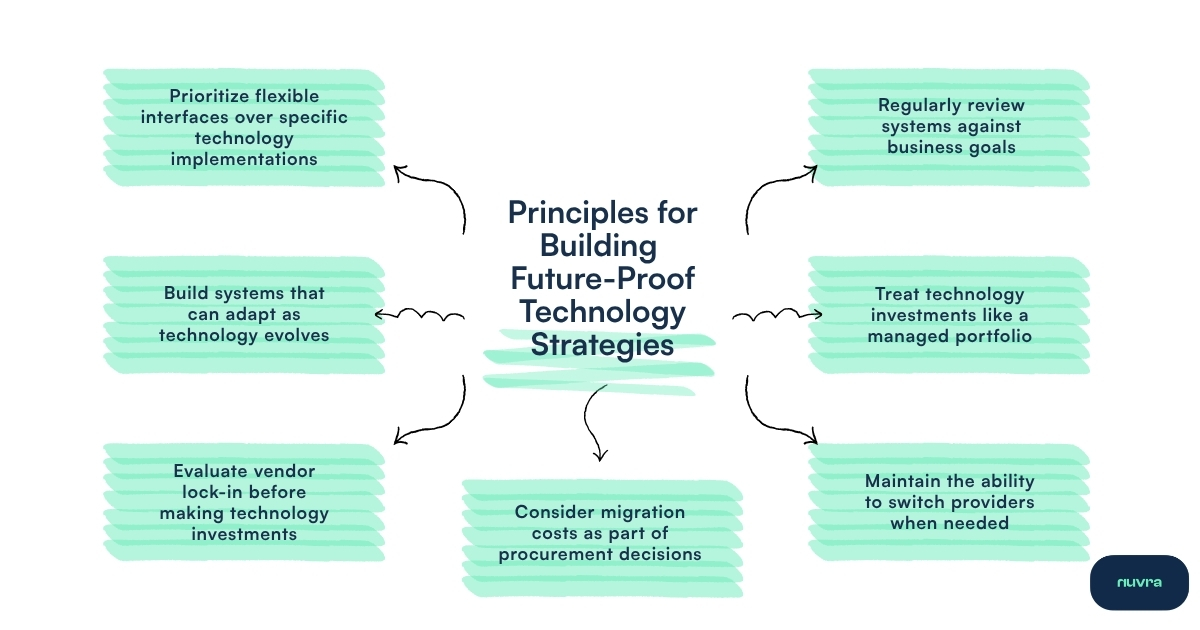
When evaluating long-term technology investments, several principles can help organizations maintain flexibility as business needs and technology capabilities evolve:
Invest in interfaces, not implementations. Specific technologies will inevitably change, but the abstraction layers connecting systems tend to survive much longer. Flexible interfaces make it easier to adapt without constantly rebuilding core infrastructure.
Make exit costs part of every decision. Vendor lock-in is often overlooked during procurement. If switching providers would require a complete rebuild, that risk should be factored into the investment decision. The ability to migrate when necessary is a critical characteristic of future-proof technology.
Review technology like an investment portfolio. Technology investments require ongoing management. Regular reviews help organizations identify outdated systems, emerging opportunities, and shifting business priorities. The goal is not to predict the future perfectly, but to remain adaptable as conditions change.
Common Future-Proofing Mistakes
Chasing Capability Instead of Business Fit
One of the most common mistakes organizations make is adopting technology because it performs well in a demonstration rather than because it solves a specific business challenge. Long-term value comes from alignment with operational needs, not feature complexity.
Treating Future-Proofing as a One-Time Project
Technology strategies often fail when future-proofing is viewed as a single architecture decision. Business priorities, customer expectations, and AI capabilities continue evolving, making continuous evaluation essential.
Separate Experimentation From Production Systems
Emerging technologies can create significant opportunities, but they should be tested in controlled environments before becoming operational dependencies. This allows organizations to explore innovation without exposing critical systems to unnecessary risk.
Adopt a Portfolio Mindset
Stable systems and emerging technologies serve different purposes. Core systems provide reliability and operational continuity, while experimental investments create future options. Managing both categories separately helps maintain balance between innovation and stability.
Avoid Designing for a Future That Doesn’t Exist Yet
Many organizations build technology stacks around assumptions about future requirements that never materialize. In an AI driven market, adaptability is often more valuable than attempting to predict exactly what comes next. The strongest technology strategies evolve alongside the business rather than remaining fixed to a single vision of the future.
Building future-proof technology is not about predicting every change in the market. It is about creating systems that can adapt as business requirements, customer expectations, and AI capabilities continue to evolve. In an AI driven market, organizations that prioritize flexibility, strong data foundations, and long-term fit are often better positioned than those chasing the latest trend. Businesses looking to evaluate technology investments, modernize their architecture, or build adaptable technology strategies can benefit from partnering with experienced teams like Nuvra.