When evaluating mobile app proposals, most teams believe they are comparing execution capability.
In reality, they are comparing how different vendors think about building your product.
At first glance, proposals tend to look similar. They include feature lists, timelines, and cost estimates. Everything appears structured, and in many cases, reasonable.
However, the real differences are not in what is written, but in how it is framed.
A strong mobile app development proposal evaluation goes beyond surface-level comparisons. It focuses on whether the proposal reflects a clear understanding of the product, the users, and the complexity involved in building it.
As one experienced product leader puts it, a credible proposal is not defined by how polished it looks, but by how clearly it demonstrates structured thinking.
Why This Stage Quietly Determines Project Success
Proposal evaluation rarely feels like the most critical step. It is often treated as a formality before development begins.
In practice, it is one of the most decisive moments in the entire project. Industry research from Standish Group shows that only around 30–35% of software projects are delivered on time and on budget, with unclear requirements and poor early-stage decisions being among the leading causes of failure.
Weak evaluation does not lead to immediate failure. Instead, it introduces small misalignments that grow over time, unclear scope, underestimated timelines, and technical decisions that do not hold up as the product evolves.
By the time these issues become visible, the project is already in motion. At that stage, changing direction is costly and disruptive.
This is why mobile app vendor selection should be treated as a strategic decision, not a transactional one.
What Most Teams Focus On and What They Miss
It is natural to compare proposals based on cost, timeline, and feature coverage. These are tangible and easy to evaluate.
But they rarely capture how the product will actually be built.
What often gets overlooked is whether the proposal explains the reasoning behind decisions. Strong proposals tend to show how the vendor approaches architecture, handles uncertainty, and plans for evolution beyond the initial release.
Weaker proposals, by contrast, often appear simpler. They present clean timelines, fixed costs, and a sense of predictability.
That simplicity is not always a strength. In many cases, it signals that complexity has been reduced or ignored rather than addressed.
Where Red Flags Usually Hide
The most common issues in proposals are not obvious mistakes. They are subtle gaps.
For example, a proposal that offers fixed timelines without any discovery phase may appear efficient, but it often indicates that assumptions have not been validated. Similarly, high-level technical descriptions without depth can suggest that important architectural decisions have not been fully thought through.
Another pattern is overconfidence. When everything in a proposal appears fast, straightforward, and predictable, it usually means that risks have not been surfaced.
In real-world product development, uncertainty is unavoidable. A credible proposal acknowledges it and plans for it.
What Proposals Often Leave Unsaid
Even well-prepared proposals tend to focus on what will be delivered, rather than how the product will evolve.
They rarely go into detail about iteration cycles, how changing requirements will be handled, or what happens after launch. Technical debt, performance optimisation, and ongoing maintenance are often underrepresented.
This creates a gap between expectation and reality, especially for founders building products intended to scale.
Understanding what is missing is just as important as understanding what is included.
A More Practical Way to Evaluate Estimates
Timelines and cost estimates are often treated as commitments. In practice, they are informed projections. A well-structured proposal usually reflects this by outlining assumptions, breaking work into phases, and allowing room for testing and iteration.
When estimates appear overly precise or rigid, it often suggests that uncertainty has not been fully accounted for. Evaluating estimates, therefore, is less about the numbers themselves and more about the thinking behind them..
This guide introduces a structured approach to mobile app development proposal evaluation, designed to help you make informed decisions with confidence. The goal is not just to choose a vendor, but to make a mobile app vendor selection that supports your product as it grows.
The 9-Step Evaluation Framework
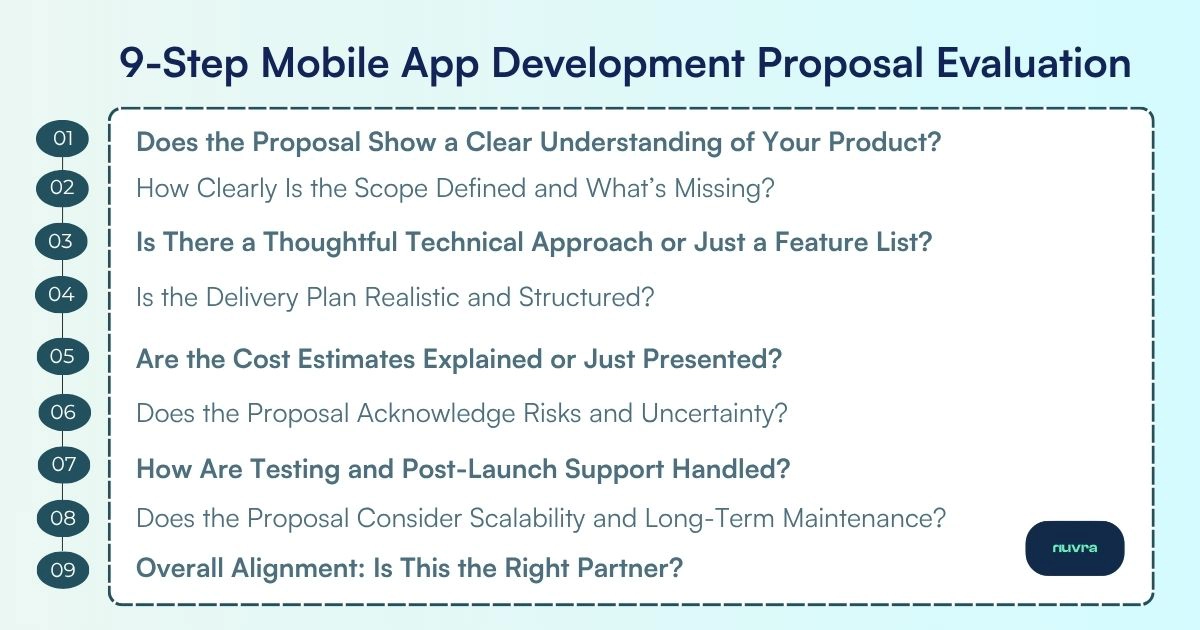
Step 1: Does the Proposal Show a Clear Understanding of Your Product?
This is the first and most important filter.
Before evaluating timelines or costs, assess whether the vendor truly understands what you’re building, and why.
A strong proposal reflects:
- A clear articulation of the product’s purpose
- Awareness of target users and their context
- Alignment with the core problem
This understanding should feel specific, not generic.
For example, a marketplace app proposal should address supply-demand balance, onboarding friction, and trust, not just list features.
If this layer is weak, everything that follows becomes unreliable. When it’s strong, it signals how the vendor will approach decisions throughout development.
Step 2: How Clearly Is the Scope Defined — and What’s Missing?
Most proposals list features. Fewer define scope clearly.
A well-structured scope should distinguish between core features and secondary enhancements, while also highlighting assumptions and areas that need further discovery.
Clarity matters more than completeness.
For example, “chat functionality” without details like real-time messaging, notifications, or moderation leaves room for interpretation, and later scope creep.
Another strong signal is whether exclusions are defined. Vendors who clearly state what’s not included tend to manage expectations better.
At this stage, you are evaluating how well uncertainty is identified and handled upfront.
Step 3: Is There a Thoughtful Technical Approach — or Just a Feature List?
Many proposals describe features. Strong ones explain how those features will be built.
A credible proposal should outline the system approach, key technology choices, and how scalability, performance, and maintainability are considered.
You’re not judging specific technologies, you’re assessing whether decisions are intentional.
Vague technical sections often indicate limited planning. On the other hand, overly complex explanations without clarity can also be a concern.
The best proposals strike a balance: technically sound, but easy to understand.
Step 4: Is the Delivery Plan Realistic and Structured?
Once the scope and approach are clear, the next step is to evaluate how the work will actually be delivered.
Many proposals include timelines, but fewer explain how those timelines are structured.
A reliable delivery plan usually breaks work into phases, such as discovery, design, development, testing, and release, rather than presenting a single end date. It also reflects the reality that software development is iterative, not linear.
What you want to see is whether the plan allows room for:
- Validation before development begins
- Iteration during the build phase
- Testing and refinement before release
When timelines appear too clean or compressed, it often means these stages have been underestimated or skipped.
A well-thought-out plan does not just show when things will be delivered. It shows how the team will get there.
Step 5: Are the Cost Estimates Explained or Just Presented?
Cost is one of the easiest elements to compare, but one of the hardest to interpret correctly.
Two proposals with similar scope can have very different pricing, and the difference is rarely arbitrary.
Instead of focusing only on the final number, look at how the estimate is constructed.
A credible proposal typically explains:
- How effort is distributed across different phases
- What assumptions have been made in arriving at the cost
- Where flexibility or variability may exist
In contrast, a flat number without explanation provides little insight into what you are actually paying for.
It is also important to assess whether the pricing reflects trade-offs. Lower costs may indicate reduced scope, limited testing, or fewer iterations. Higher costs may include more robust planning, scalability considerations, or post-launch support.
The goal is not to choose the lowest estimate, but to understand what each estimate represents.
Step 6: Does the Proposal Acknowledge Risks and Uncertainty?
Every software project involves uncertainty. The difference lies in how it is handled.
Stronger proposals tend to acknowledge this directly. They identify assumptions, highlight potential risks, and explain how those risks will be managed.
This might include areas such as:
- Dependencies on third-party integrations
- Unclear or evolving requirements
- Performance or scalability considerations
Weaker proposals often do the opposite. They present a smooth, predictable path with little mention of risk.
At first, this can feel reassuring. In practice, it usually means that complexity has not been fully addressed.
A vendor who openly discusses risks is not being cautious, they are being realistic. This transparency is often a strong indicator of how they will communicate and problem-solve during the project.
Step 7: How Are Testing and Post-Launch Support Handled?
Testing is one of the most underestimated parts of app development, and one of the most commonly underdefined in proposals.
Many proposals mention testing briefly, but don’t explain how it will be done or how much time is allocated to it.
A reliable proposal treats testing as an integral part of development, not a final step. It should reflect:
- Continuous testing during development, not just at the end
- Clear ownership of QA processes
- Time allocated for bug fixing and stabilization
Equally important is what happens after launch.
Post-launch support is often either vague or missing entirely. However, real-world products require ongoing monitoring, updates, and performance improvements once users start interacting with them.
If this phase is not clearly addressed, it usually becomes an afterthought, both in planning and budgeting.
Step 8: Does the Proposal Consider Scalability and Long-Term Maintenance?
A mobile app is rarely a one-time build. It evolves with users, business needs, and market conditions.
The proposal should reflect some level of thinking beyond the initial release.
This does not mean overengineering from day one. It means making reasonable decisions that allow the product to grow without major rework.
For example, look for whether the proposal considers:
- Modular architecture that can be extended over time
- Flexibility in adding new features or integrations
- Maintainability of the codebase as the product evolves
Proposals that focus only on immediate delivery often ignore these aspects. While this may reduce short-term cost, it can significantly increase long-term complexity.
A balanced approach acknowledges current constraints while keeping future growth in mind.
Step 9: Overall Alignment — Is This the Right Partner?
After evaluating all technical and execution aspects, the final step is broader.
You are not just selecting a proposal. You are selecting a partner.
At this stage, step back and assess overall alignment:
- Does the vendor’s thinking align with your product goals?
- Do they communicate clearly and transparently?
- Are they proactive in highlighting risks and trade-offs?
Often, the best proposal is not the most detailed or the most affordable. It is the one that demonstrates clarity, honesty, and a structured approach to problem-solving.
This aligns with a key insight from experienced founders:
A team that thinks well will consistently outperform one that simply promises more.
Making the Right Decision: From Proposal to Partnership
By the time you’ve worked through all nine steps, the goal is not just to compare proposals, it’s to build confidence in a decision that will hold up over time.
A mobile app is not delivered once. It evolves, adapts, and grows with your business. The proposal you choose today directly shapes how that journey unfolds.
What becomes clear through a structured mobile app development proposal evaluation is that the best choice is rarely the one with the lowest cost or fastest timeline. It is the one that reflects clear thinking, realistic planning, and honest communication.
In many cases, the differences between proposals are subtle on the surface but significant in execution. Vendors who acknowledge uncertainty, explain their decisions, and define boundaries clearly are more likely to navigate complexity effectively once development begins.
Ultimately, strong mobile app vendor selection comes down to this:
You are choosing a team that will make dozens of critical decisions after the proposal stage, many of which are not yet visible.
Choosing a team that thinks clearly is what ensures those decisions move your product forward, not backward.
If you approach proposal evaluation with that mindset, you are far more likely to avoid costly missteps and build a product that can scale with confidence.