By 2026, mobile applications will power more than $600+ billionin annual global revenue and influence nearly every digital interaction.
Enterprises are no longer building apps simply to “go mobile.” They’re re-architecting business models around mobile-first ecosystems, cloud-native back-ends, secure data pipelines, AI-driven personalization, and 5G-enabled performance.
In the IT services landscape, mobile apps sit at the convergence of software engineering, user experience, and business transformation. Whether a logistics provider optimizes real-time tracking or a bank enhances client authentication through biometrics, the outcome is the same: faster decisions, seamless engagement, and measurable ROI.
This guide explores what mobile app development really entails, why it remains a strategic IT investment, and how organizations can prepare to build future-ready solutions that align with the pace of digital change.
What Is Mobile App Development?
Mobile App Development is the end-to-end process of designing, building, integrating, testing, and maintaining applications that operate on mobile devices.
From an IT-services perspective, it’s about engineering connected systems, where the app is only the presentation layer sitting on robust APIs, microservices, and secure cloud infrastructure.
Core Components of Modern App Development
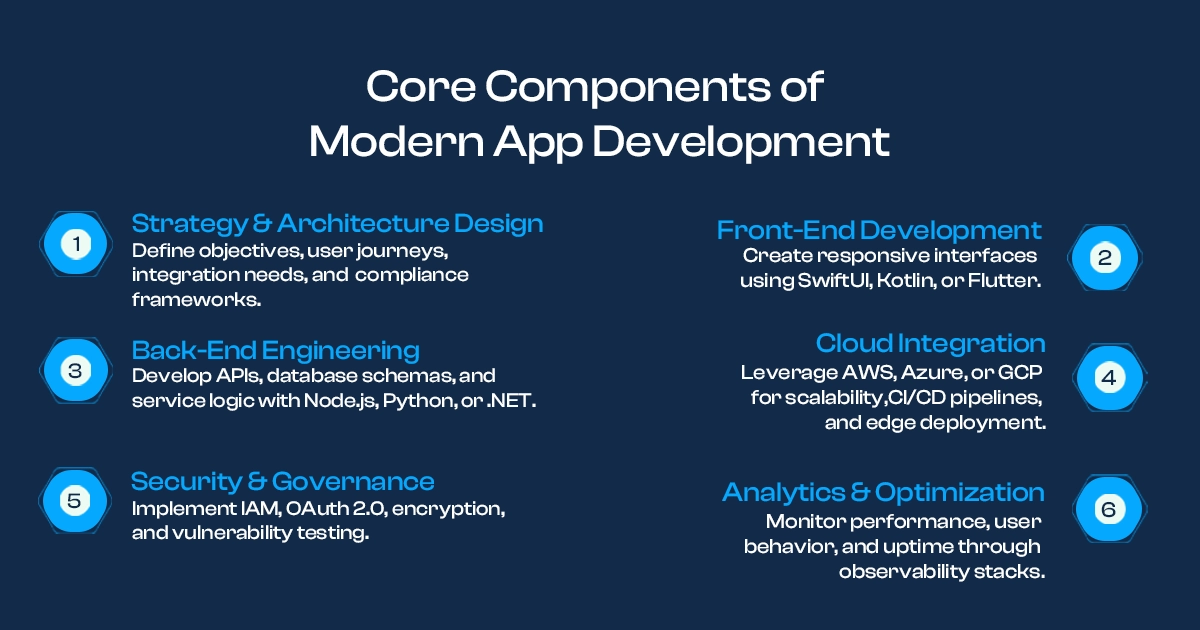
- Front-End Development – Create responsive interfaces using SwiftUI, Kotlin, or Flutter.
- Back-End Engineering – Develop APIs, database schemas, and service logic with Node.js, Python, or .NET.
- Cloud Integration – Leverage AWS, Azure, or GCP for scalability, CI/CD pipelines, and edge deployment.
- Security & Governance – Implement IAM, OAuth 2.0, encryption, and vulnerability testing.
- Analytics & Optimization – Monitor performance, user behavior, and uptime through observability stacks.
- Types of Mobile Apps
| Type | Description | Ideal Use Case |
| Native Apps | Developed specifically for iOS or Android using their native languages. | When performance, UX, and deep hardware integration are priorities. |
| Cross-Platform Apps | Built using frameworks like Flutter or React Native to share code across OSs. | When time-to-market and cost efficiency matter. |
| Progressive Web Apps (PWAs) | Browser-based apps that function offline and resemble native apps. | When accessibility and lightweight delivery are essential. |
| Hybrid Apps | Combine web and native code. | When enterprises need rapid multi-platform presence with moderate performance demands. |
Expert Insight:
For enterprise IT teams, choosing the app type isn’t only about UX—it’s an architectural decision that impacts API design, DevOps workflows, and long-term maintenance. For enterprise IT teams, choosing the app type isn’t only about UX, it’s an architectural decision that impacts API design, DevOps workflows, and long-term maintenance.
Experts emphasize that security and the underlying cloud model are the two technical decisions with the greatest long-term impact on a mobile app’s success. These choices shape everything from compliance readiness and data protection to scalability, performance, and operational cost over the app’s lifecycle.
Why Enterprises Invest in Mobile App Development
The mobile channel has matured from a convenience layer to a core IT capability. Companies use apps to extend their digital ecosystems, integrate cloud workloads, and capture customer intelligence at the edge.
1. Business Continuity and Accessibility
Apps deliver 24×7 availability and device-agnostic access to enterprise services, especially critical for sectors like finance, healthcare, and field operations.
2. Data as a Competitive Asset
Modern apps act as data collectors, capturing behavioral, transactional, and contextual data streams that feed into analytics and AI pipelines.
This enables predictive maintenance, personalized recommendations, and smarter supply-chain decisions.
3. Enhanced Customer and Employee Experience
Whether a consumer uses a retail app or an engineer accesses an internal dashboard, intuitive mobile interfaces shorten task cycles and reduce friction.
4. Integration with Cloud and Edge Ecosystems
With 5G and distributed cloud, apps now process workloads closer to the user, reducing latency and improving resilience.
5. Operational Efficiency through Automation
Mobile DevOps, CI/CD, and microservices allow teams to release updates rapidly, automate quality checks, and optimize costs.
6. Future-Proofing the Enterprise Stack
Investing in modular, API-driven mobile architectures ensures adaptability to new devices (wearables, AR headsets, IoT sensors) and future frameworks.
How Mobile App Development Works — An Enterprise Perspective
Building a high-performing mobile application is no longer a standalone design or coding task. It’s a collaborative engineering process that aligns architecture, DevOps, cybersecurity, and user experience within a single digital ecosystem.
Here’s how IT teams and service providers like Nuvra structure an enterprise-grade mobile app project:
1. Discovery and Solution Architecture
Every project begins with a deep-dive into the business case and technical landscape.
Activities include:
- Defining use cases and user roles.
- Conducting feasibility studies on integrations (ERP, CRM, IoT, AI, etc.).
- Choosing between monolithic, modular, or microservices architectures.
- Designing a scalable cloud topology, hybrid, multi-cloud, or edge.
Expert Tip:
At this stage, document non-functional requirements — performance, compliance (GDPR, HIPAA), uptime SLAs, and recovery objectives. These drive architectural decisions later.
2. UX/UI Design for Enterprise Contexts
Enterprise design balances aesthetics with function. A mobile app for technicians in the field demands clarity and offline resilience; an executive dashboard app prioritizes data visualization.
Key Design Steps:
- Create user journey maps around job roles.
- Prototype with accessibility (WCAG) and localization in mind.
- Validate navigation and task completion with pilot users.
Example: A logistics firm designing a driver app used heat-mapping analytics to reposition key buttons, cutting average task time by 40 %.
3. Selecting the Right Technology Stack
Technology defines an app’s lifespan. Below is a breakdown of modern, future-ready components commonly used by IT service teams.
Front-End (Client Layer)
| Platform | Languages / Frameworks | Ideal Use Case |
| iOS | Swift, SwiftUI | Secure, performance-centric consumer or enterprise apps. |
| Android | Kotlin, Jetpack Compose | Field-service, data-intensive Android environments. |
| Cross-Platform | Flutter, React Native, Kotlin Multiplatform | Consistent UI and faster delivery across OSs. |
| Web / PWA | Angular, Vue.js, Svelte | Lightweight portals or companion dashboards. |
Back-End (Server Layer)
| Stack | Highlights | When to Choose |
| Node.js + Express | Non-blocking, real-time APIs. | Chat, tracking, or IoT telemetry. |
| Python (Django/Flask) | Quick to prototype, ML-friendly. | Data analytics or AI-integrated apps. |
| .NET Core | Enterprise security and AD integration. | Regulated industries, B2B systems. |
| Java (Spring Boot) | Mature ecosystem, scalable microservices. | Financial and transactional apps. |
| Serverless (AWS Lambda, Azure Functions) | Pay-per-execution scalability. | Event-driven or intermittent workloads. |
Databases
- SQL: PostgreSQL, MySQL for relational structures.
- NoSQL: MongoDB, DynamoDB for flexible, large-scale data.
- In-Memory: Redis for caching and speed.
Cloud & DevOps Toolchain
- CI/CD Pipelines: GitHub Actions, Jenkins, Bitrise.
- Containerization: Docker + Kubernetes.
- Monitoring: New Relic, Datadog, Prometheus.
Security Layer
- End-to-end encryption (AES-256).
- OAuth 2.0 / OpenID Connect for authentication.
- Mobile App Management (MAM) policies via Intune or AirWatch.
Pro Tip: Always design with compliance-as-code, embed security scans and license checks in CI/CD to detect issues before deployment.
4. Development & Integration
Agile methodology dominates enterprise app delivery.
Teams operate in 2-week sprints, pushing tested builds to a shared staging environment.
Integration Focus Areas:
- APIs: REST, GraphQL, gRPC.
- Third-Party Services: Payment gateways, geolocation, messaging (Twilio, Firebase).
- Enterprise Systems: SAP, Salesforce, ServiceNow, or custom data lakes.
Example: A Canadian healthcare network integrated its appointment app with HL7-compliant hospital systems, cutting manual scheduling time by 60 %.
5. Testing and Quality Assurance
Testing spans multiple layers:
| Type | Purpose | Tools |
| Unit & Integration | Validate functions and service communication. | JUnit, Mockito |
| UI/UX | Verify usability across devices. | Appium, Espresso, XCUITest |
| Performance | Stress-test load and responsiveness. | JMeter, K6 |
| Security | Scan for OWASP Top 10 issues. | Burp Suite, ZAP |
| Accessibility & Compliance | Ensure inclusive design. | Axe, Wave |
Automation reduces regression risk and accelerates release cycles.
Expert Advice: Maintain a dedicated testing environment mirroring production, same API endpoints, anonymized data, identical configurations.
6. Deployment & Optimization
Deployment pipelines automate the transition from staging to production.
IT teams use blue-green or canary releases to minimize downtime.
App Store Optimization (ASO) for public apps still matters: write keyword-optimized descriptions, design high-impact screenshots, and localize metadata.
Post-launch optimization includes:
- Crash analytics (Firebase Crashlytics).
- Feature usage telemetry.
- Automated rollback policies in case of failures.
7. Maintenance & Continuous Improvement
Mobile app development doesn’t end at release; it evolves with OS updates, new devices, and shifting business needs.
Continuous Activities:
- Update dependencies regularly to patch vulnerabilities.
- Monitor performance KPIs (load time, API latency, error rate).
- Introduce new modules through feature toggles for controlled rollouts.
Example: An Australian fintech updated its digital-wallet app to support biometric payments when iOS Face ID API matured, keeping UX current without redesigning the core stack.
Enterprise Mobile App Architecture
A robust app is built on layered, modular architecture ensuring maintainability and scalability.
- Presentation Layer: Handles UI and device interactions.
- Domain / Business Logic Layer: Executes rules, workflows, and calculations.
- Data Layer: Manages persistence, caching, and synchronization.
- Integration Layer: Connects APIs, cloud services, and enterprise middleware.
Best Practices:
- Apply Clean Architecture or MVVM.
- Separate configuration via environment variables.
- Implement API gateways for unified security and throttling.
Choosing the Right Development Approach
| Approach | Advantages | Limitations | Ideal For |
| Native | Maximum performance and full hardware access. | Higher cost, longer timeline. | Complex, mission-critical enterprise apps. |
| Cross-Platform | Shared codebase, faster delivery. | Slight UI lag, dependency on frameworks. | Startups or internal tools. |
| Hybrid | Combines web flexibility with native access. | Limited native feel. | MVPs or moderate-complexity solutions. |
| PWA | Low cost, instant deployment, SEO-friendly. | Restricted device access. | Informational or customer-service apps. |
There’s no “best” approach, only the one aligned with business goals, integration depth, and security posture.
However, a recurring challenge for enterprises is frequent shifts in requirements and insufficient market analysis before development begins. These issues often matter more than the choice of native vs cross-platform vs hybrid.
As we move toward 2026, the development approach that wins will be the one supported by strong upfront planning, stable requirements, and a well-defined development process. Without these foundations, even the most technically sound approach can lead to scope creep, rework, and missed timelines.
Mobile App Development Across 10 Industries
Mobile technology has evolved from a convenience layer into a core operational channel. Every industry now leverages mobile ecosystems, not just for customer engagement, but for automation, analytics, and decision-making.
Here’s how 10 major sectors are using mobile app development to stay competitive and future-ready.
1. Healthcare
Healthcare is one of the most dynamic adopters of mobile technologies. Apps today go far beyond teleconsultation, they enable remote diagnostics, patient monitoring, and digital therapeutics.
- Current Example:
Teladoc Health (U.S.) provides real-time virtual consultations across specialties and integrates with wearable devices for continuous vitals tracking. - Emerging Use Case:
Maple (Canada) integrates electronic health records (EHR) with mobile consultations, allowing doctors to prescribe and monitor treatment plans securely within one app. - Future Concept:
Predictive care apps will use AI and IoT sensors to analyze real-time biometrics and recommend interventions before symptoms escalate — imagine an app that notifies your cardiologist of early arrhythmia patterns.
Insight:
Global health outlooks indicate that a substantial and growing share of healthcare interactions now happens through digital and mobile channels, from telehealth visits to remote monitoring apps, and that this digital share will continue to rise through the mid‑2020s.
2. Financial Services (Fintech)
The fintech revolution continues to redefine how consumers and businesses interact with money.
- Current Example:
Revolut (U.K. / Global) offers multi-currency management, investing, and payments under one interface. - Emerging Use Case:
Wealthsimple (Canada) integrates AI to guide investment strategies for millennial users while ensuring compliance through mobile KYC verification. - Future Concept:
Next-generation apps will combine blockchain-based identity, voice biometrics, and predictive fraud detection, creating frictionless yet secure experiences for global banking.
3. Education and EdTech
Education has shifted from classrooms to cloud-based ecosystems. Mobile learning apps are central to this transformation.
- Current Example:
Coursera (U.S.) lets learners pursue degrees via mobile, syncing progress across devices seamlessly. - Emerging Use Case:
EdApp (Australia) uses microlearning and gamification to improve employee training engagement. - Future Concept:
AR/VR-powered apps will deliver immersive, hands-on lessons — like virtual chemistry experiments or 3D anatomical simulations accessible via phone.
Insight: The global m-learning market will reach $80 billion by 2027, driven by corporate upskilling initiatives.
4. Retail and E-Commerce
For retail, mobile apps are the new storefront. They blend personalization, loyalty, and seamless transactions.
- Emerging Use Case:
Woolworths (Australia) integrates location-aware promotions and contactless checkout through its app. - Future Concept:
AI-driven retail apps will predict shopping needs, auto-order essentials, and enable virtual fitting rooms using AR technology.
Pro Tip:
Retailers that successfully shift to mobile‑first experiences generally report higher repeat‑purchase rates and engagement than those relying on web‑only storefronts, as apps keep brands one tap away on the customer’s home screen.
5. Logistics and Supply Chain
Mobility is redefining logistics, from real-time visibility to predictive optimization.
- Current Example:
FedEx Mobile (U.S.) provides real-time package tracking integrated with predictive delivery times using machine learning. - Emerging Use Case:
Fleet Complete (Canada) offers IoT-based fleet monitoring, tracking driver behavior and fuel efficiency in real time. - Future Concept:
Autonomous-vehicle coordination apps will dynamically reroute shipments based on weather, demand, and traffic conditions, integrated directly with warehouse robotics.
Insight:
One market forecast values the global smart and mobile supply chain solutions market at more than 32 billion USD by 2026.
6. Manufacturing and Industry 4.0
Manufacturers are leveraging mobile apps to connect humans, machines, and analytics platforms.
- Current Example:
Siemens MindSphere Mobile allows operators to monitor factory KPIs remotely, tracking OEE (Overall Equipment Effectiveness) from anywhere. - Emerging Use Case:
Predictive maintenance apps use IoT and machine learning to forecast machinery failures — reducing downtime by up to 40%. - Future Concept:
Mobile digital-twin interfaces will enable engineers to manipulate 3D plant models in augmented reality for real-time troubleshooting.
With connected IoT devices forecast to exceed 21 billion by 2026, driven heavily by industrial and manufacturing deployments, mobile interfaces are quickly becoming the default way for frontline teams to interact with plant‑floor data.
7. Real Estate and PropTech
Mobile-first solutions are revolutionizing how people buy, sell, and experience property.
- Current Example:
Zillow (U.S.) offers interactive listings with 3D tours and instant mortgage estimates. - Emerging Use Case:
REA Group (Australia) integrates AI to match users with homes based on lifestyle preferences. - Future Concept:
Imagine AR HomeStage, a future app allowing buyers to visualize different furniture layouts or renovations using augmented reality overlays before purchase.
Expert Tip: Case studies show AR‑enhanced property listings can close 20–30% faster and drive significantly higher engagement.
8. Travel and Hospitality
From booking to post-trip feedback, mobile has become the traveler’s constant companion.
- Current Example:
Airbnb (Global) integrates dynamic pricing, AI recommendations, and contactless check-ins. - Emerging Use Case:
Qantas Airways (Australia) provides real-time flight updates and biometric boarding. - Future Concept:
AI-powered itinerary assistants will dynamically adjust travel plans based on real-time weather, local events, or personal preferences.
Insight:
A travel‑tech report notes that a majority of travelers now use smartphones at multiple points in the journey, including research, booking, and in‑trip management, with mobile devices overtaking desktop as the primary touchpoint for many audiencesz
9. Agriculture and AgriTech
Agriculture is increasingly data-driven, and mobile apps make precision farming accessible.
- Current Example:
AgriWebb (Australia) helps farmers record livestock and paddock data, optimizing yield and compliance. - Emerging Use Case:
Drone-linked mobile apps visualize crop health and soil conditions using satellite data. - Future Concept:
AI-driven advisory apps could recommend seed types, irrigation schedules, and pest control using predictive models trained on regional data.
Key Takeaway:
A meta‑analysis of mobile phone–mediated agricultural interventions finds that digital advisory and information services are associated with significant gains in yields and farm incomes across multiple countries, by improving farmers’ access to timely agronomic information.
10. Government and Public Services
Governments worldwide are embracing digital mobility for transparency and accessibility.
- Current Example:
MyServiceNSW (Australia) centralizes multiple services — from driver licenses to business registrations — into one app. - Emerging Use Case:
Smart-city dashboards deliver air quality, public transport, and utility data to citizens in real time. - Future Concept:
Mobile identity wallets leveraging blockchain will allow citizens to verify credentials securely without sharing personal data.
In 2024, about 70% of EU citizens used online public services, up from around 58% in 2019, reflecting a rapid shift toward digital‑first government service delivery.
Emerging Trends in Mobile App Development
Mobile app development is now at the intersection of AI, cloud, data, and security, and these technologies are redefining what’s possible. Alongside these shifts, enterprises are also rethinking how apps are built, with rapid prototyping and low-cost experimentation becoming core expectations.
Here’s what the next evolution of enterprise mobility looks like.
1. AI Everywhere — Contextual and Predictive Apps
AI-driven personalization will go beyond recommendations to full context awareness.
Apps will anticipate user intent, adjust content dynamically, and make predictive decisions using on-device ML models (reducing cloud dependency).
Industry insight: Predictive analytics is emerging as a foundational capability, with enterprises increasingly expecting apps to forecast behavior, needs, and next-best actions in real time.
Example: A retail app predicts when a product will run out based on purchase patterns and proactively offers a reorder discount.
2. Edge and 5G-Enabled Experiences
5G and edge computing will move data processing closer to users — cutting latency and enabling speed-critical use cases such as AR navigation, telemedicine, and autonomous vehicle operations.
Example: A logistics app in a 5G zone can update shipment routes in real time based on live traffic feeds and vehicle sensors.
3. Low-Code, No-Code, and the Rise of “Vibe Coding”
Low-code and no-code adoption will accelerate — but the bigger shift is how enterprises use these tools.
Teams are increasingly exploring “vibe coding”: a rapid prototyping mindset where ideas are assembled quickly using AI-driven builders and then refined by technical specialists.
This shift enables two major outcomes:
- Faster idea-to-prototype cycles
- Lower development costs, as early-stage builds require minimal engineering resources
As this approach matures, specialized roles such as vibe-coding fixers, experts who refine, stabilize, and productionize AI-generated prototypes, are expected to become standard within enterprise development teams.
4. Super Apps and Micro Experiences
Instead of single-purpose apps, enterprises are consolidating services under Super Apps — modular ecosystems that combine payments, chat, workflows, and analytics.
At the same time, micro apps are gaining traction as lightweight, task-specific tools that complement larger systems for employees, partners, and field teams.
5. Cybersecurity by Design
As mobile usage grows, so does the attack surface.
Enterprises are moving toward Zero-Trust security, biometric authentication, and secure enclaves to protect data in motion and at rest.
Industry insight: Cybersecurity expertise is becoming a non-negotiable component of mobile app teams. With more rapid prototyping and AI-generated code, organizations are investing in dedicated security specialists to review, harden, and maintain application integrity.
Regulatory frameworks will continue evolving around privacy-first architectures — including data minimization and consent auditing.
6. Sustainable App Engineering
Energy-efficient coding, optimized APIs, and resource-aware design will become sustainability imperatives.
Green cloud hosting and real-time performance monitoring will help enterprises keep their digital carbon footprints within ESG targets.
7. Web3 and Decentralized Identities
The next frontier of secure digital identity is decentralized.
Apps will increasingly integrate blockchain-based identity wallets for verification — eliminating repetitive logins and reducing dependency on centralized credential storage.
Example: A citizen app could verify employment or education credentials without exposing personal data.
Implementation Checklist for Enterprises
Here’s a step-by-step roadmap for IT leaders and product teams building mobile apps that last:
- Define Purpose and KPIs
Clarify who the app serves and what outcomes (efficiency, engagement, revenue) it must deliver. - Tip: Tie KPIs to measurable IT metrics like uptime, transaction speed, or adoption rates.
- Assemble a Cross-Functional Team
Include developers, UX designers, cloud architects, QA, cybersecurity, and business analysts. - Select Architecture and Stack Early
Choose whether to build natively or cross-platform; define your cloud model and CI/CD pipeline from Day 1. - Prototype and Validate Fast
Create clickable wireframes, gather user feedback, and iterate before writing production code. - Embed Security at Every Layer
Use secure authentication, data encryption, and compliance frameworks (GDPR, HIPAA, SOC2). - Automate Testing and Monitoring
Implement automated regression tests and real-time logging to detect performance anomalies. - Integrate Analytics and Feedback Loops
Deploy telemetry dashboards to track feature adoption and identify friction points. - Plan for Scale
Containerize services, use load balancers, and plan for horizontal scalability. - Schedule Continuous Updates
Keep pace with OS changes, libraries, and frameworks — treat maintenance as part of DevOps. - Evaluate Success and ROI
Analyze whether the app improves process efficiency, customer satisfaction, or revenue outcomes.
Treat app development as an ongoing IT service, not a one-time project. The best apps evolve continuously through user data, analytics, and innovation cycles.
Mobile App Development as a Strategic IT Discipline
Mobile app development isn’t just about building a functional product; it’s about designing intelligent, secure, and scalable digital ecosystems that drive real business outcomes. For enterprises, apps have become the connective tissue between users, devices, and data. Organizations that integrate robust architecture, continuous innovation, and cloud-native engineering will stay ahead of disruption.
From AI-powered personalization to zero-trust security and edge computing, the future belongs to those who treat mobile development as an IT-driven discipline, one that blends strategy, user experience, and technology excellence. The path forward is clear: build apps that adapt, evolve, and grow with your enterprise.