The question “What is the mobile app development cost in 2026?” is straightforward. The answer is not.
This is particularly critical as the global mobile application market is projected to reach $378 billion in 2026, fueled by a landscape where 75% of new applications are now being built using low-code and AI-assisted technologies.
In earlier years, pricing conversations centered around visible components: number of screens, integrations, and supported platforms. Cost is shaped more by structural decisions than surface-level features.
Mobile applications today are expected to:
- Scale reliably
- Integrate AI intelligently
- Protect user data rigorously
- Perform consistently across devices
- Evolve continuously after launch
As a result, budgeting for a mobile app, requires clarity about long-term goals, not just launch requirements.
For founders and enterprises serving US and international markets, cost planning must reflect product ambition, compliance obligations, and infrastructure expectations. Underestimating these factors rarely reduces cost, it usually postpones it.
This guide breaks down:
- Average mobile app development cost in 2026
- What drives pricing up or down
- How budgets are distributed across phases
- Ongoing post-launch expenses
- Strategic budgeting principles that reduce long-term waste
Average Mobile App Development Cost
Complexity remains the primary determinant of cost. However, complexity is best understood in terms of backend logic, integrations, scalability requirements, and data handling, not simply visual design.
Below is a realistic cost range for professionally built applications targeting global markets:
App Type | Estimated Cost (USD) | Typical Timeline |
Simple / MVP | $20,000 – $50,000 | 2–4 months |
Mid-Level Business App | $50,000 – $150,000 | 5–8 months |
Complex / Enterprise App | $150,000 – $500,000+ | 9+ months |
These estimates assume structured discovery, professional UI/UX, proper QA testing, and deployment readiness.
Let’s clarify what each category includes.
1. Simple Application (MVP)
A Minimum Viable Product in typically includes:
- Core functionality only
- User authentication
- Basic backend infrastructure
- Admin controls
- Standard analytics integration
An MVP is not intended to be feature-rich. Its purpose is validation. However, even at this stage, architectural decisions must allow for expansion.
The cost difference between a disposable prototype and a scalable MVP may not be visible immediately. It becomes visible when growth begins.
2. Mid-Level Business Application
This category represents many SaaS platforms and operational tools. It often includes:
- Multiple user roles
- Payment gateway integration
- API integrations
- Data dashboards
- Performance monitoring
- Role-based access systems
Applications at this level require thoughtful backend planning and structured testing cycles.
This is also the stage where AI-driven features, such as smart recommendations or conversational interfaces, begin influencing budget.
3. Complex or Enterprise-Grade Application
Enterprise-level applications involve higher system demands, including:
- Large user concurrency
- Advanced security requirements
- Compliance considerations
- Real-time data synchronization
- Multi-region cloud deployment
- Advanced analytics
At this level, architecture determines longevity. Poor early decisions can result in expensive refactoring or rebuilding.
Budget planning must therefore account for long-term system integrity, not just launch readiness.
Why Cost Conversations Have Changed?
Mobile app development cost in 2026 reflects broader shifts in technology and regulation.
Three major trends are shaping modern budgets:
- AI integration as an expected feature
- Cross-platform development maturity
- Security and compliance as mandatory components
In the next section, we will examine these cost drivers in detail and explain how they influence project budgets.
The Key Cost Drivers Shaping Mobile App Development
While complexity still determines base cost, three structural shifts are influencing how budgets are formed:
- AI integration expectations
- Cross-platform development maturity
- Security and compliance requirements
These are no longer optional upgrades. They are strategic components of serious digital products.
1. AI Integration: From Optional to Expected
In previous years, AI features were often considered experimental. In 2026, they are increasingly standard across industries.
Common AI integrations include:
- Conversational assistants
- Smart search functionality
- Predictive recommendations
- Document analysis
- Workflow automation
Integrating AI into a mobile application typically adds $10,000 to $40,000 to baseline development cost, depending on scope and complexity.
However, the primary cost driver is not the AI model itself. It is the surrounding infrastructure:
- Data structuring
- API orchestration
- Real-time processing
- Monitoring and optimization
- Compliance and transparency measures
For example, integrating large language model APIs or recommendation systems requires secure backend orchestration and ongoing monitoring.
AI should be implemented because it improves outcomes, not because it is trending. Poorly planned AI features often increase cost without increasing product value.
Today, hybrid roles are emerging, engineers who specialize in reviewing and hardening AI-generated code. These professionals reduce long-term maintenance risk and shift budget from raw coding hours to structural quality assurance.
2. Cross-Platform vs Native Development
Technology choice has significant budget implications.
Frameworks such as:
- Flutter
- React Native
have matured considerably.
Building for both iOS and Android using a cross-platform framework is typically 30–40% more cost-efficient than developing two independent native applications.
Cross-platform development allows:
- Shared codebase
- Faster feature deployment
- Reduced maintenance overhead
- Unified update cycles
Native development, using Swift for iOS and Kotlin for Android, remains relevant for:
- High-performance gaming
- Hardware-intensive apps
- Advanced AR/VR functionality
For most business applications, cross-platform offers balanced efficiency and scalability. The correct choice depends on product ambition, not just cost reduction.
3. Security and Compliance as Core Budget Components
Security has become a non-negotiable line item.
Privacy regulations and user expectations require security by design. This typically represents 10–15% of the total development budget.
This includes:
- Encrypted data storage
- Secure authentication mechanisms
- Multi-factor authentication
- API protection
- Role-based permissions
- Activity logging
For products serving US markets, compliance expectations are particularly high. Security cannot be retrofitted efficiently after launch. It must be embedded into architecture from the beginning.
Where the Money Actually Goes: Phase-Wise Budget Allocation
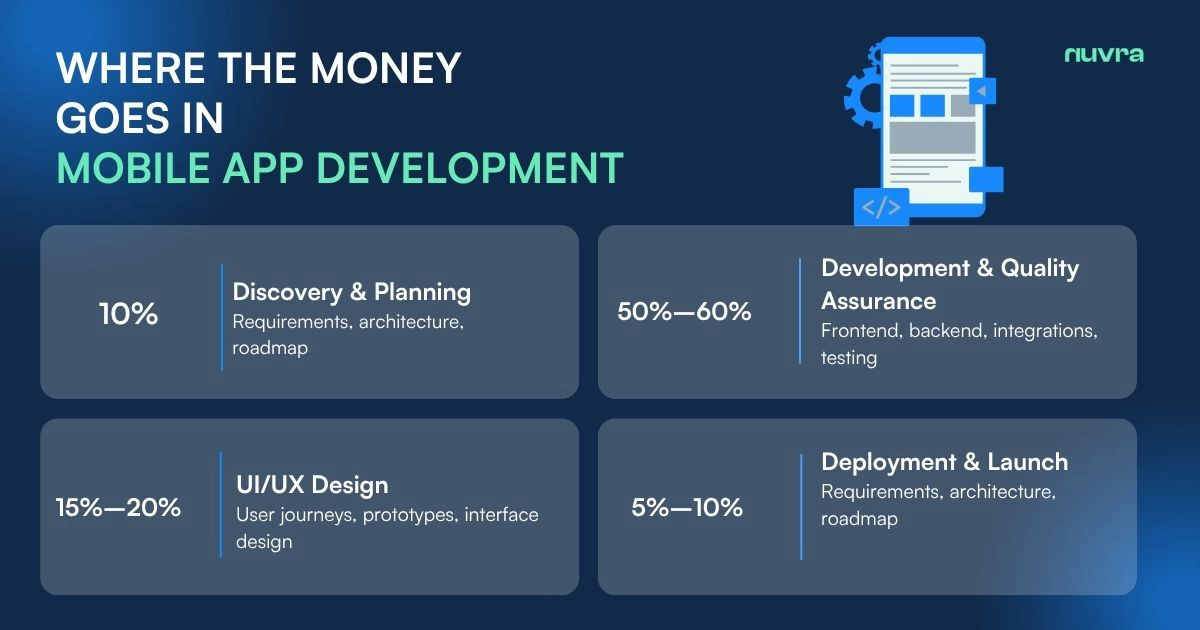
Understanding cost distribution clarifies what you are paying for.
A professionally structured mobile app development project typically allocates budget as follows:
1. Discovery & Planning (≈10%)
Discovery includes:
- Requirement definition
- System architecture planning
- Risk analysis
- Technical feasibility validation
- Timeline and roadmap alignment
This phase reduces ambiguity. Compressing discovery to reduce cost often shifts uncertainty into development, which increases rework later.
2. UI/UX Design (≈15–20%)
Design involves:
- User journey mapping
- Wireframes and prototypes
- High-fidelity interface design
- Usability testing
Well-structured UX reduces friction, improves adoption, and minimizes revision cycles during development.
3. Development & Quality Assurance (≈50–60%)
This is the largest portion of the budget.
It includes:
- Frontend implementation
- Backend architecture
- Database modeling
- API integration
- Third-party service integration
- Automated and manual testing
Quality assurance is particularly important, as apps are expected to function reliably across devices, OS versions, and network conditions.
Cutting QA reduces upfront cost but increases long-term maintenance burden.
4. Deployment & Launch (≈5–10%)
Deployment includes:
- App Store submission
- Google Play registration
- Production server configuration
- Monitoring setup
For reference:
- Apple Developer Program: $99/year
- Google Play Console: $25 one-time
While these fees are minimal, infrastructure readiness and monitoring tools represent meaningful operational planning.
The Hidden Cost Most Founders Overlook: Year 2 and Beyond
One of the most common budgeting mistakes in mobile app development is assuming that development cost equals total product cost.
In practice, building the app is only the beginning.
In 2026, annual maintenance and operational expenses typically represent 15–20% of the original development cost.
For example:
- If development costs $100,000
- Annual maintenance may range between $15,000 and $20,000
This ongoing budget covers:
- Server hosting and cloud infrastructure
- Performance monitoring
- Operating system updates
- Security patches
- Minor feature refinements
- Bug fixes and optimization
Applications that fail to allocate maintenance budgets often accumulate technical debt. Over time, this increases instability and forces reactive development.
Maintenance is not a sign of failure. It is a structural component of responsible product ownership.
Infrastructure and Hosting Considerations
Cloud infrastructure plays a critical role in operational cost.
Applications hosted on platforms such as Amazon Web Services or Microsoft Azure are billed based on usage, including compute time, database queries, storage, and data transfer.
Costs vary significantly depending on:
- Number of active users
- Data storage volume
- Real-time processing requirements
- AI model usage
- Geographic distribution
For early-stage products, hosting may start modestly. As user base grows, infrastructure cost scales accordingly.
Poorly optimized systems can inflate hosting expenses unnecessarily. Efficient architecture reduces long-term operational burn.
Strategic Budgeting Principles
Rather than asking how to build the cheapest app, a more productive question is how to structure the investment responsibly.
Below are principles that reduce long-term risk.
1. Start with an MVP — But Build It Correctly
Launching with a Minimum Viable Product allows validation before committing to full-scale investment.
However, an MVP should still:
- Use scalable backend architecture
- Maintain clean database structure
- Support modular expansion
The objective is controlled experimentation, not disposable development.
2. Use Modular Architecture
Modular systems allow:
- Adding AI components later
- Introducing new integrations
- Scaling individual services independently
- Avoiding full rewrites
This approach protects long-term investment and supports gradual evolution.
3. Avoid Overengineering Early
While scalability is important, excessive upfront complexity increases cost without immediate return.
The balance lies in:
- Building a stable foundation
- Avoiding speculative features
- Prioritizing validated user needs
Disciplined scoping reduces unnecessary burn.
4. Choose Technology Based on Product Goals
Technology decisions should align with:
- Expected performance load
- Integration complexity
- User experience requirements
- Long-term roadmap
For many SaaS and operational applications, cross-platform frameworks such as Flutter or React Native provide efficiency without sacrificing quality.
Native development is justified when performance requirements demand it, not simply by default preference.
What Influences Cost the Most?
If we simplify the discussion, five factors account for most budget variation:
- Product complexity
- AI integration depth
- Security and compliance standards
- Scalability expectations
- Post-launch support structure
Everything else, including design polish or store submission, is secondary in comparison.
Clarity in these five areas reduces estimation volatility and prevents scope creep.
Takeaway
The mobile app development cost in 2026 reflects more than development hours. It reflects architectural decisions, AI integration strategy, regulatory requirements, and long-term scalability planning.
For founders and enterprises targeting global markets, responsible budgeting requires discipline. Underestimating cost often leads to rebuilding. Overengineering leads to unnecessary burn.
The goal is balance:
- Validate early
- Architect responsibly
- Secure data properly
- Scale deliberately
- Maintain continuously
A mobile application is not a one-time project. It is an evolving system.
Understanding where the money goes, and why, allows organizations to treat development as an investment rather than an expense.