When founders think about building a product, whether it’s a mobile app, a web platform, or an AI-powered system, most of the focus naturally goes into features, timelines, and budgets. The engagement model is often treated as a secondary decision, something to finalize after everything else is clear.
In reality, it works the other way around.
The way you engage a development team has a direct impact on how your product evolves. It shapes how quickly decisions are made, how easily changes can be introduced, and how much ownership the team takes over time. In many cases, the difference between a smooth product journey and a frustrating one can be traced back to this single choice.
The challenge is that most engagement models sound reasonable at a surface level. Fixed price appears predictable, dedicated teams seem like a larger commitment, and retainers feel flexible but loosely defined. Without deeper context, it is easy to choose based on what feels financially safer rather than what fits the nature of the product.
This is where many teams run into trouble.
From experience, one of the most common patterns is choosing a fixed-price model for a product that is still evolving. Research from Standish Group shows that requirements change in over 60% of software projects during development, making rigid, fixed-scope models difficult to sustain for products that are still evolving.
The intention is to control costs, but the result is often the opposite, rigid scope, constant change requests, and growing misalignment between expectations and delivery.
This is not a problem with the model itself. It is a problem of fit.
A Simple Way to Frame the Decision
Before comparing the models in detail, it helps to look at them through a different lens.
Each model represents a different relationship between you and the team:
- A fixed-price model is centered around delivering a predefined outcome
- A dedicated team model is built around continuous product development
- A retainer model supports ongoing improvements and maintenance
The key difference lies in how much change the model can absorb. Some models work best when everything is known upfront, while others are designed to adapt as the product evolves.
Understanding this distinction makes the rest of the comparison much clearer.
What is Fixed Price vs Dedicated Team vs Retainer? (With Real Scenarios)
1. Fixed Price Model
A fixed price model is built around a clearly defined scope. Before development begins, the requirements, features, timelines, and costs are agreed upon in detail. The expectation is simple: the team delivers exactly what was specified, within the agreed budget.
This model works well when there is very little ambiguity in what needs to be built. For example, if a company wants to build a marketing website, a simple web application, a lightweight mobile app, or replicate an already validated feature set, fixed price can provide clarity and cost control.
Where it becomes challenging is in environments where learning and iteration are required. Most digital products, especially early-stage ones do not have fully stable requirements. As user feedback comes in, priorities shift. New features emerge, and existing ones need to be rethought.
In a fixed price setup, these changes are not naturally absorbed. They are treated as scope changes, which means renegotiation, delays, and sometimes friction between teams.
This is why fixed price often feels efficient at the beginning but slows down over time as reality diverges from the original plan.
2. Dedicated Team Model
A dedicated team model shifts the focus away from delivering a fixed scope and toward building and evolving a product over time. Instead of paying for a predefined outcome, you are investing in a team that works continuously on your product.
This model is particularly effective when the product is expected to evolve, which is the case for most startups and growing platforms. Requirements are not locked upfront. Instead, they are refined as the team learns from users, data, and market feedback.
One of the key advantages here is alignment. Because the team stays involved over a longer period, they build context around the product, understand its goals, and take more ownership in decision-making. This reduces the need for constant re-explanation and allows for faster iteration cycles.
From a practical standpoint, this means fewer interruptions. There is no need to pause and renegotiate scope every time something changes. The team adapts with the product.
This model aligns incentives around long-term product success rather than short-term delivery. It enables continuous learning and stronger outcomes over time.
3. Retainer Model
A retainer model sits somewhere between the other two. It provides ongoing access to a team, but typically with a defined monthly capacity rather than full-time dedication.
This model is commonly used for support, maintenance, and incremental improvements. For example, after a product has launched, a company may need regular updates, bug fixes, performance improvements, or small feature additions. A retainer allows this work to happen consistently without setting up a new contract for every change.
It can also be useful for teams that need occasional development support but do not yet require a full dedicated team.
However, the trade-off is intensity. Because the engagement is not fully focused on rapid product development, progress tends to be steady rather than fast. For companies trying to build or scale a product quickly, this model may not provide the momentum needed.
A Simple Way to Compare Them in Practice
Instead of thinking about these models only in terms of pricing or structure, it helps to look at how they behave in real scenarios:
- If your product is clearly defined and unlikely to change, fixed price provides control and predictability
- If your product is evolving and requires continuous iteration, a dedicated team offers the flexibility and alignment needed
- If your product is already built and needs ongoing support or gradual improvement, a retainer provides consistency without overcommitment
The important distinction is not which model is better overall, but which one fits the current state of your product, and this is also a critical factor when choosing the right development partner.
How These Models Impact Speed, Flexibility, and Product Quality
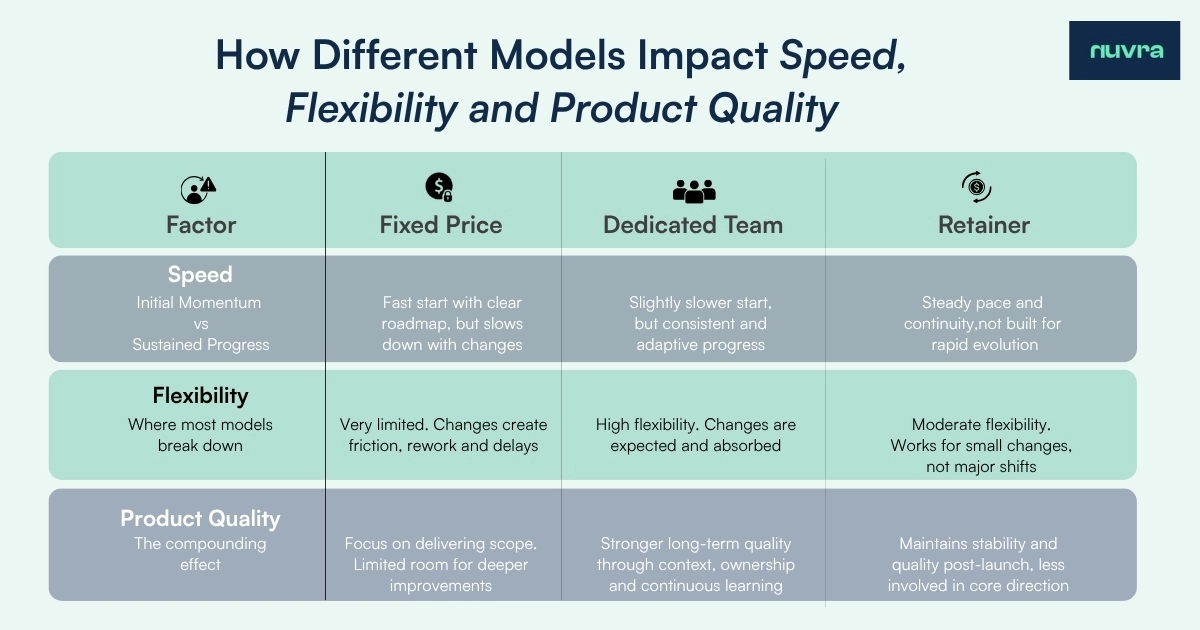
Choosing an engagement model is not just an operational decision. It directly affects how your product moves, adapts, and matures over time.
To understand this clearly, it helps to look at three factors that matter in every product journey: speed, flexibility, and long-term quality.
Speed: Initial Momentum vs Sustained Progress
At first glance, fixed price often appears to be the fastest option. Since everything is defined upfront, development can begin quickly with a clear roadmap.
However, this speed is highly dependent on one assumption, that the initial scope is accurate and complete.
In practice, that assumption rarely holds. As soon as new insights emerge, the process slows down. Changes need to be evaluated, scoped again, and approved, which introduces delays that were not visible at the beginning.
A dedicated team, on the other hand, may feel slightly slower to start because it involves setting up workflows, communication, and priorities. But once in motion, it tends to maintain consistent speed. The team can adapt without stopping, which results in smoother and more predictable progress over time.
Retainers provide a different kind of pace. They are not designed for rapid development but for steady continuity. Work moves forward consistently, but without the intensity required for fast product evolution.
Flexibility: Where Most Models Break Down
Flexibility is where the differences between these models become more pronounced.
Fixed price offers very limited flexibility. Any deviation from the original plan introduces friction, not because teams are unwilling to adapt, but because the structure of the model does not support ongoing change. This often leads to a cycle of change requests, reprioritization, and renegotiation.
A dedicated team is built for flexibility. Since the focus is on the product rather than a fixed scope, changes are expected and absorbed as part of the process. This allows teams to respond quickly to user feedback, market shifts, and new insights without disrupting momentum.
Retainers offer moderate flexibility. Small changes and incremental improvements can be handled easily, but larger shifts in direction may require rethinking the engagement or expanding capacity.
Over time, flexibility tends to become a defining factor in whether a product succeeds or struggles. Products rarely fail because they moved too fast, they fail because they could not adapt.
Long-Term Product Quality: The Compounding Effect
Product quality is not just about code, it is about how well decisions evolve over time.
In a fixed-price model, the focus is often on delivering what was agreed upon. While this can produce solid results for well-defined projects, it can also limit deeper improvements. The team’s involvement is tied to scope completion, not ongoing product success.
A dedicated team naturally leads to stronger long-term quality. As the team builds context and stays involved, they begin to understand not just what to build, but why it matters. This results in better technical decisions, more thoughtful feature development, and fewer compromises.
This aligns with a broader principle we see across successful products: continuous learning leads to better outcomes.
Retainers contribute to quality in a different way. They help maintain stability after launch by ensuring that issues are addressed and improvements are made consistently. However, they are less suited for shaping the core direction of a product.
A Pattern Worth Noticing
Across these three factors, a clear pattern emerges.
- Fixed price optimizes for predictability at the start, but struggles with change
- Dedicated teams optimize for adaptability and long-term outcomes
- Retainers optimize for consistency and continuity
The challenge is that many decisions are made based on short-term comfort rather than long-term fit. This is where the gap between expectation and reality begins to widen.
How to Choose What Actually Fits Your Product
Choosing between fixed price, dedicated team, and retainer is not about selecting the “best” model. Each one works well in the right context.
The real decision comes down to understanding the nature of your product.
If your requirements are stable and unlikely to change, a fixed-price model can provide clarity and control. If your product is evolving, and most mobile apps, web platforms, and AI-enabled systems are, a dedicated team gives you the flexibility and alignment needed to build something that improves over time. If your product is already live and needs steady support, a retainer helps maintain momentum without unnecessary overhead.
What we have consistently encountered at Nuvra is choosing based on cost predictability alone often leads to problems. It may feel safer in the short term, but if the model does not match how your product evolves, that predictability quickly disappears.
For early-stage products in particular, the ability to learn, adapt, and iterate is far more valuable than locking everything upfront. You are not just building features, you are discovering what works.
A model that supports that process will almost always lead to better outcomes.
At Nuvra, this is often part of the early conversations we have with founders and product teams. The goal is not to push a specific model, but to align the approach with how the product is expected to evolve, so that execution remains smooth as the product grows.