Most founders assume that once an MVP is live, the next step is straightforward, start building more features and expand the product.
In practice, this is where things become less clear.
You now have:
This creates a subtle but important shift.
Before MVP, decisions are driven by assumptions and hypotheses. After MVP, decisions need to be driven by evidence and interpretation.
The challenge is that many teams don’t fully make this transition.
Instead, they continue operating in “build mode,” adding features based on:
The result is usually the same:
A product that grows in complexity, but not in clarity or adoption.
What the Data Shows
This isn’t just a pattern, it’s well documented.
These numbers point to a consistent issue: More product does not mean better product.
The Core Shift You Need to Make
After MVP, your role as a founder or product owner changes.
You are no longer just deciding what to build.
You are now responsible for understanding:
Only then does it make sense to decide what comes next.
At Nuvra, this is something we emphasize early in post-launch phases, product growth comes from refinement before expansion .
This guide is designed to give you a clear, practical way to approach your roadmap after MVP.
We’ll cover:
The goal is not to give you a rigid framework, but a way to think clearly about product decisions when the signals are still forming.
Early-stage teams tend to over-index on feedback:
While all of this is useful, it has a limitation, it reflects what users say, not what they actually do.
Post-MVP roadmap decisions should be grounded in behavioral signals, such as:
This distinction matters more than it seems.
For example, a user might request a feature, but if they’re not consistently using the core product, adding more functionality won’t solve the underlying issue.
Instead of collecting more ideas, try mapping your product into three zones:
Your roadmap should focus primarily on the second category.
Every product has a central action, the thing that defines whether it’s useful.
This is often simple, but easy to overlook.
Some examples:
This is what users come back for.
If this behavior is weak, inconsistent, or delayed, the product will struggle, regardless of how many features you add.
How to Find It (Without Overcomplicating)
Ask three questions:
That last point is especially important.
Research from Mixpanel shows that users who reach a clear aha moment early are significantly more likely to retain over time.
What This Means for Your Roadmap
If users are:
Until this is stable, expanding the product usually adds complexity without improving outcomes.
Once you’ve identified core behavior, the next step is understanding what’s getting in the way.
This is where most of your roadmap value sits in the early stage.
Common Friction Points in MVPs
Across products, we consistently see similar issues:
These are not “big features,” but they have disproportionate impact.
Why This Matters More Than Feature Expansion
Improving friction points directly impacts:
In contrast, adding features often spreads attention thinner without fixing the core experience.
This aligns closely with how strong product teams operate:
they treat early roadmaps as refinement cycles, not expansion phases.
Before moving to prioritization, it helps to structure what you’re seeing.
Here’s a practical way to translate behavior into roadmap inputs:
Step A: Observe
Step B: Diagnose
Step C: Act
This keeps your roadmap grounded in real usage, not assumptions.
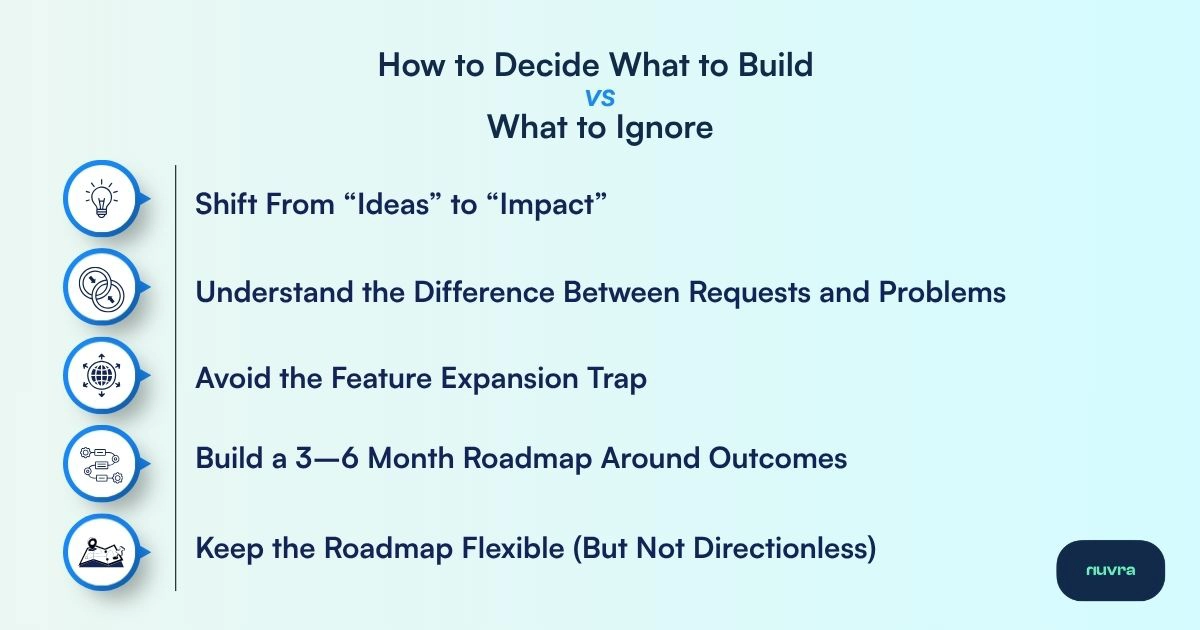
Once you understand user behavior and friction points, the next challenge is decision-making.
This is where most post-MVP roadmaps lose clarity.
You’ll typically have:
The risk is not lack of ideas. It’s lack of filtering.
Not every good idea deserves to be built.
In early-stage products, the only ideas that matter are those that change user behavior in a measurable way.
A simple way to evaluate this:
Will this improve how often, how quickly, or how effectively users get value?
If the answer is unclear, it’s usually not a priority.
A Practical Prioritization Filter
Before adding anything to your roadmap, test it against these four questions:
If something doesn’t pass at least two of these, it’s likely noise.
This is where many founders struggle, they treat all inputs equally, especially early user feedback.
But in reality: Volume of requests does not equal importance.
Users often describe solutions, not problems.
For example:
These are requests.
But underneath them, the real issues might be:
If you build exactly what users ask for, you risk solving the wrong layer of the problem.
A Better Approach
Instead of asking “What should we build?”, ask:
Then design a solution aligned with your product direction.
This is how you balance:
One of the most consistent patterns in funded startups is this:
As soon as there is traction (or funding), teams feel pressure to expand the product.
This usually leads to:
But not necessarily:
Why This Happens
Feature expansion feels like progress because:
But from a product perspective, it often dilutes focus.
What Strong Teams Do Instead
They invest in:
This is less visible, but far more effective.
As highlighted in Nuvra’s product approach, early-stage success is often driven by making products clearer and more reliable before expanding scope.
Once priorities are clear, the roadmap itself needs to be structured correctly.
A common mistake is treating the roadmap as a feature list. Instead, it should be a set of outcomes tied to metrics.
What a Strong Roadmap Typically Includes
Across the first 3–6 months post-MVP, most effective roadmaps focus on three areas:
1. Core Flow Improvements
2. Product Reliability & Performance
3. Controlled Experiments
Metrics That Should Anchor Your Roadmap
Every roadmap item should connect to at least one of these:
If a roadmap item doesn’t tie back to a metric, it becomes difficult to evaluate whether it worked.
A Simple Way to Structure It
Instead of writing:
Frame it as:
This shifts the focus from output → outcome.
Even a well-structured roadmap should not be rigid.
Post-MVP is still a learning phase.
You will uncover:
Best Practice
This doesn’t mean constantly changing direction. It means refining direction based on evidence.
After MVP, the pressure to move fast is real, especially in funded startups.
But speed without clarity often leads to:
A strong product roadmap does something different.
It slows down just enough to understand:
And then builds deliberately from there.
If You Take One Thing Away
Focus less on expanding your product, and more on strengthening it.
Because in the early stages, growth doesn’t come from how much you build,
it comes from how well your product works for the users you already have.