
Building an app is rarely cheap, but for most founders, the bigger problem isn’t the size of the budget. It’s how easily that budget gets drained by the wrong decisions.
In real product development, waste rarely comes from obvious failures alone. More often, it happens quietly through unnecessary features, poor planning, unclear priorities, and technical decisions that seem harmless early on but become expensive over time.
Many startups assume budget overruns are caused by development itself. In reality, the biggest losses often happen before code becomes the issue. Products get overloaded before validation, teams build based on assumptions instead of user behavior, and short-term savings create long-term inefficiencies.
The result is familiar: delayed launches, mounting rework, bloated systems, and budgets that disappear faster than expected.
For founders, understanding where development budgets are most commonly wasted is one of the most valuable ways to protect both capital and product momentum.
One of the most common ways startups overspend is by trying to build a fully realized product before validating whether users actually need it.
This often starts with good intentions. Founders want to create a competitive product, impress investors, or prepare for future scale. But in practice, this usually leads to oversized MVPs packed with features that haven’t been tested, prioritized, or proven necessary.
Instead of focusing on the core user problem, teams often invest heavily in:
This approach burns budget quickly because every additional feature increases design time, development complexity, testing requirements, and future maintenance.
The trade-off here is speed versus certainty.
Building too much too soon often delays real market feedback, which is the very thing startups need most early on.
The leanest products often learn the fastest because they focus on validating essential user journeys first.
For most founders, the smarter move is not building everything they might eventually need. It’s building only what they need to confirm the product deserves further investment.
Even strong budgets can disappear quickly when product teams are misaligned.
This usually happens when founders, designers, and developers are not operating from the same definition of success.
If requirements are vague, priorities shift frequently, or assumptions replace real validation, development becomes reactive rather than strategic.
The consequences include:
What feels like flexibility early in the process often becomes inefficiency later.
This is especially common in startup environments where founders are still refining their product vision while development is already underway.
Without clear documentation around:
teams may move quickly, but often in the wrong direction.
And building the wrong thing efficiently is still expensive.
The real budget killer here is rework.
Every misunderstanding compounds cost because changes made later are almost always more expensive than decisions made earlier.
Founders who prioritize clarity before completeness tend to protect their budgets far better than those who rush into execution without alignment.
A well-defined product roadmap does not eliminate flexibility. It ensures flexibility happens strategically rather than chaotically.
Some of the costliest app development mistakes don’t look expensive at first.
In fact, many begin as seemingly minor technical decisions made early to save time or accelerate launch.
Founders often underestimate how choices around architecture, backend structure, integrations, and data models can shape every future stage of product growth.
For example:
These decisions may reduce early costs, but they often create friction with every future release.
Simple product improvements become slower. New features require more engineering effort. Performance issues become harder to solve. Entire systems may eventually require partial or full rewrites.
This is where technical debt quietly compounds.
The challenge isn’t that founders need enterprise-level infrastructure from day one. Overengineering can be just as wasteful.
The real goal is choosing foundations that support near-term speed without sabotaging long-term adaptability.
The trade-off is rarely between cheap and expensive.
It’s between strategic and reactive.
A product built on unstable technical foundations may launch faster, but it often costs far more over its lifecycle.
Discovery is one of the first areas many founders cut when budgets feel tight.
On paper, skipping deep planning can look like efficiency. Less time spent on workshops, user journeys, or product scoping can seem like progress. In reality, this is often where budgets begin leaking.
Without proper discovery, teams frequently move into development without clear answers to critical questions:
When these answers are unclear, development becomes vulnerable to shifting assumptions.
This often leads to:
Every adjustment increases both cost and delivery time. What many founders discover too late is that unclear requirements don’t reduce complexity. They simply push complexity deeper into the process, where fixing it becomes more expensive.
A strong discovery process acts less like an added expense and more like budget insurance.
It creates alignment before resources are committed. For startups especially, clarity around the core user journey often protects more capital than aggressive cost-cutting ever could.
Trying to save money early is understandable. Founders are under pressure to preserve runway, move quickly, and reduce upfront spend wherever possible. But some cost-cutting decisions create far greater expenses later.
Common examples include:
These shortcuts often lower immediate invoices while increasing long-term product instability.
The consequences usually show up as:
This is particularly dangerous when founders optimize for lowest initial price instead of total cost of ownership.
A cheaper build that requires major repairs six months later is rarely cheaper. The same applies to vendor decisions. Low-cost teams without strong strategic guidance may deliver code, but not necessarily product success.
The best development partnerships reduce waste not simply by writing software, but by helping founders avoid solving the wrong problems.
That distinction often determines whether budgets create growth or disappear into avoidable corrections.
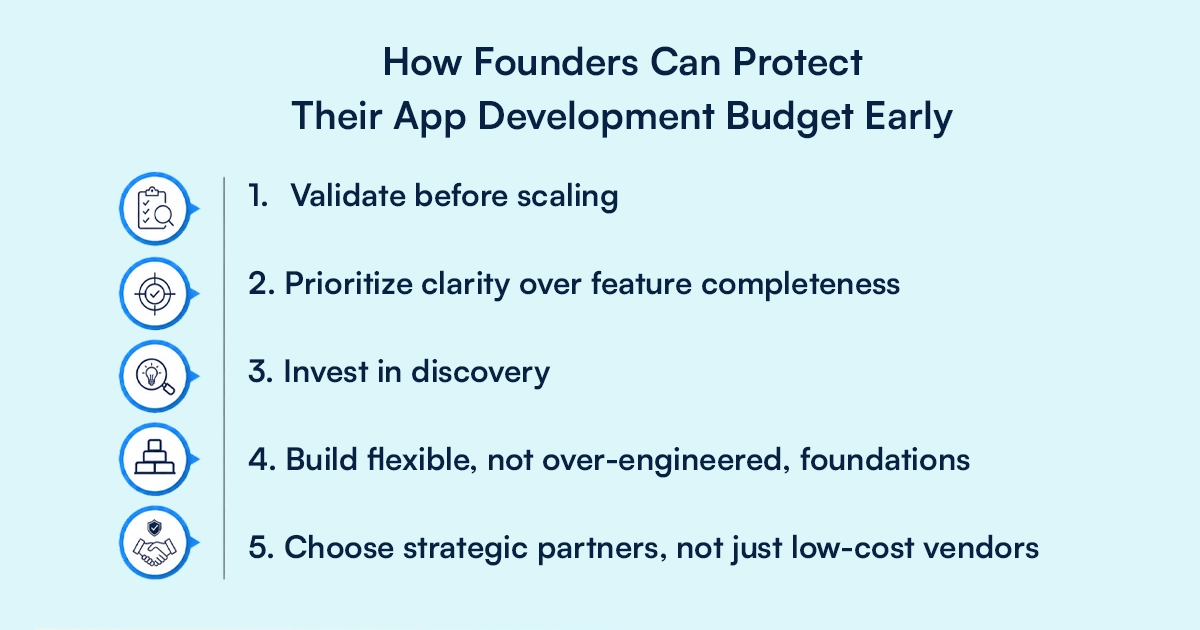
Avoiding wasted budget does not require founders to predict every future challenge.
It requires clarity around what matters most.
The founders who manage budgets effectively are usually not the ones spending the least. They are the ones making disciplined product decisions early.
Here are the most practical ways to reduce avoidable spend:
Before investing in advanced systems or large feature sets, confirm users genuinely need the core product.
Focus first on:
A smaller product with aligned goals will outperform a bloated roadmap built on assumptions.
Define:
Discovery often feels optional when budgets are tight, but it is one of the strongest forms of cost prevention.
Solid planning reduces:
Founders should avoid both extremes:
The ideal technical strategy supports current growth while preserving future adaptability.
Development teams should provide more than execution.
The right partner helps with:
This is where true budget protection often happens.
App development budgets are rarely wasted because founders invest too much.
They are usually wasted because resources are directed toward the wrong priorities at the wrong time.
Unvalidated features, unclear planning, weak technical foundations, and short-term savings often create hidden expenses that compound as products evolve. For startups and scaling businesses alike, protecting budget is less about reducing spend and more about increasing strategic precision.
The strongest products are not built by avoiding investment. They are built by ensuring every investment solves the right problem. For founders planning digital products, budget discipline begins long before development starts. It begins with clarity.