
As digital products grow more complex, composable software architecture has emerged as a way for organizations to build systems that are easier to scale, maintain, and evolve. Traditional architecture become harder to manage as applications expand. Their tightly coupled systems force teams to review and test entire applications creating development bottlenecks, slower release cycles, and increased operational complexity.
As a result, modern product development increasingly requires systems that allow teams and services to operate more independently, without affecting the stability of the entire application. Composable architecture addresses this by separating applications into modular components that can be updated, scaled, and maintained independently, boosting the efficiency of development.
At its core, composable architecture refers to building applications through independently managed components or services instead of relying on a single tightly connected system. In composable software architecture, different parts of an application can be updated, scaled, or maintained without forcing teams to modify the entire platform.
This approach allows organizations to isolate functions based on business requirements and operational needs. For example, services such as payments, user authentication, search, or trackers can be reviewed and developed independently depending on how the business grows. As modern systems become larger and more interconnected, this level of flexibility has become increasingly important for sustainable product development.
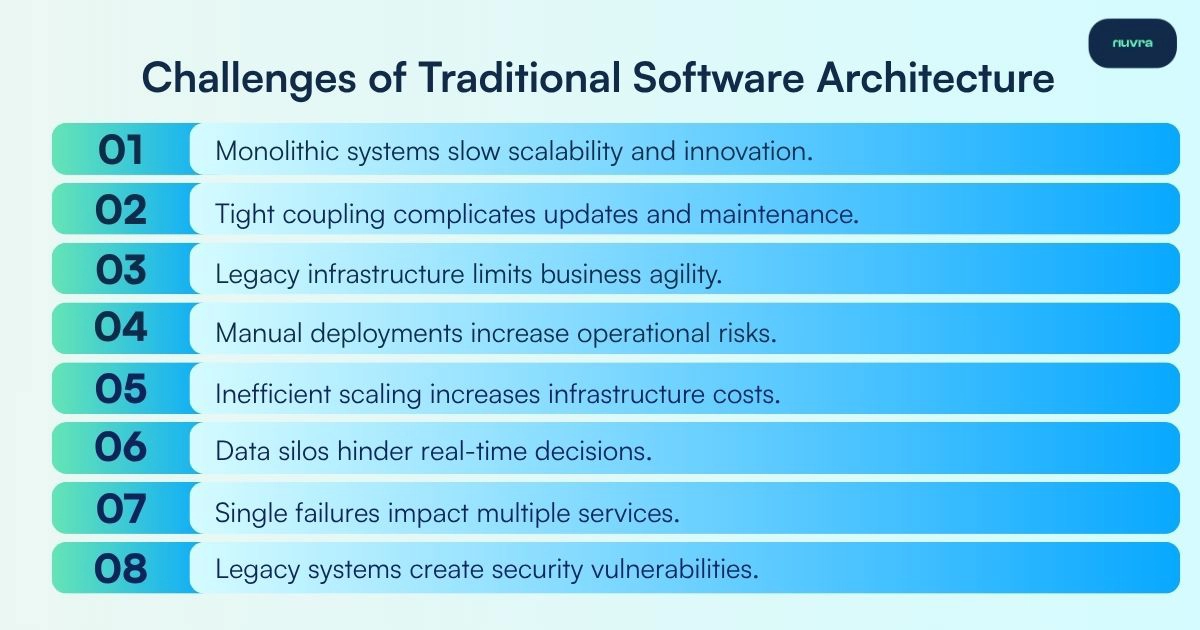
Traditional architectures are typically designed around highly interconnected applications where components share dependencies and workflows. While this model can work effectively during the early stages of growth, it becomes harder to manage as systems expand and development teams increase in size.
As applications expand, tightly connected systems can create several operational challenges that affect scalability and development efficiency, including:
This is where composable architecture introduces a more modular approach. Instead of treating the application as one connected system, composable architectures separate functionality into independently managed services that can be updated, deployed, and scaled separately. Teams gain greater autonomy because changes can be isolated without affecting the wider platform.
For organizations focused on long-term product development, this structure can improve development agility while reducing coordination overhead.
Composable systems are usually introduced when operational complexity begins slowing development efficiency. In many growing organizations, teams eventually reach a stage where dependencies become difficult to manage and release cycles become increasingly time-consuming.
Some common indicators include unrelated features breaking after updates, teams blocking each other during deployments, or developers spending more time resolving dependencies than building new functionality. In many cases, organizational growth begins outpacing the team’s ability to maintain development speed.
This is often the point where composable software architecture becomes a strategic operational decision rather than a technology trend. The goal is not simply to modernize infrastructure, but to allow systems and teams to evolve more independently as complexity increases.
One of the biggest misconceptions around composability is that it automatically simplifies system management. In practice, composability does not remove complexity, but it makes it easier to manage by redistributing it.
Instead of managing one tightly connected application, organizations manage distributed services, inter-service communication, and operational coordination across multiple systems. While this improves flexibility and scalability, it also requires stronger governance and operational discipline.
Understanding these trade-offs early on in the product development cycle, allows businesses to better assess the viability of composability for their needs.
As systems grow larger, sustainable product development increasingly depends on how effectively organizations can isolate and manage different parts of an application. In traditional environments, failures can spread across unrelated services because dependencies are deeply interconnected.
Composable systems reduce this risk by separating responsibilities into independent services. Teams can diagnose issues more efficiently because failures remain localized instead of affecting the wider application. Maintenance also becomes easier because services can be updated individually without requiring full application redeployments.
This structure also improves component reuse across products and workflows. As digital ecosystems grow, composable software architecture helps organizations maintain greater control over scaling and maintenance requirements without constantly restructuring the broader platform.
Successful composability depends heavily on deciding which parts of a system should operate independently. Services that evolve independently, support distinct workflows, or have separate ownership structures are often strong candidates for modularization.
On the other hand, components that consistently change together may create unnecessary operational overhead when separated. In many cases, business boundaries provide the clearest indicators for how systems should be divided.
This is important because composable software architecture introduces coordination requirements that tightly connected systems may not face. Organizations need to ensure modularity improves operational efficiency instead of increasing unnecessary complexity.
One of the biggest concerns organizations have with modular systems is whether development speed decreases as services become more distributed. In practice, it depends heavily on operational tooling and standardization.
Teams typically maintain efficiency through clear API contracts, shared libraries, and standardized deployment pipelines that reduce coordination issues across services. Without this operational foundation, modular systems can create friction instead of improving agility.
Sustainable product development depends not only on architecture decisions, but also on the workflows that support collaboration across development teams.
Although composability improves flexibility and scalability, it does not automatically simplify system management. Organizations still need to manage distributed tracing, service coordination, versioning, and onboarding complexity across multiple systems.
As applications continue scaling, maintaining consistency across independent services also becomes more challenging. For this reason, adopting composable software architecture requires organizations to approach composability as an operational strategy rather than a standalone technical upgrade.
Composable software architecture helps organizations support long-term product development through more scalable and maintainable systems. Businesses exploring modular software strategies can benefit from partnering with experienced teams like Nuvra.