

People often think designing scalable backend systems is just about handling traffic, when the real challenge is adapting to change. Modern software development increasingly depends on backend architectures that can evolve without creating operational bottlenecks, technical debt, or unnecessary complexity, not just load handling. Building systems that scale sustainably requires balancing flexibility, maintainability, and simplicity from the very beginning.
One of the biggest misconceptions around scalability is that backend systems fail primarily because of traffic. In reality, many systems struggle because they become too difficult to modify as products, workflows, and operational requirements evolve over time.
Designing scalable backend systems therefore begins with adaptability rather than infrastructure. Before thinking about scaling traffic, organizations need to establish clear data ownership, service boundaries, and operational responsibilities that support sustainable software development.
Selecting the right architecture pattern depends as much on organizational structure as technical requirements. Different architectures solve different operational problems, and choosing the wrong model too early can introduce unnecessary complexity.
Well-structured monoliths are often the most practical option for smaller teams and early-stage products. They simplify deployments, reduce operational overhead, and allow teams to move quickly without managing distributed infrastructure.
For many organizations, a modular monolith creates enough flexibility without introducing the complexity associated with distributed services. This approach often supports faster software development because teams spend less time coordinating infrastructure and more time building product functionality.
Microservices become more valuable when organizations have distinct scaling requirements, independent deployment cycles, and teams that map clearly to service ownership. They improve flexibility by allowing services to evolve independently, but they also introduce significant operational complexity.
While scalable backend systems often rely on distributed services at larger scale, microservices are not automatically the correct starting point. Smaller teams managing too many services frequently experience slower delivery cycles and greater operational overhead.
In many real-world scenarios, hybrid architectures provide the most balanced solution. Organizations often begin with modular monoliths and gradually extract services as operational pressure increases.
This approach reduces premature complexity while still creating extension points for future growth. Instead of designing infrastructure around hypothetical scale, teams can evolve architecture based on real operational needs.
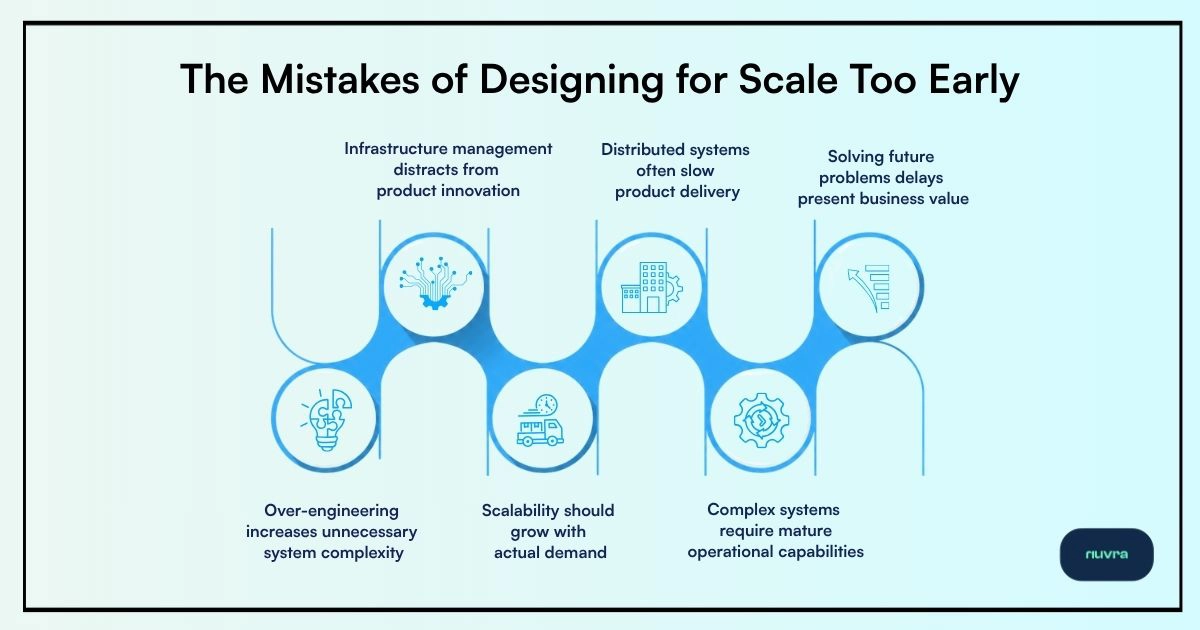
One of the most common architectural mistakes is solving scalability problems before they actually exist. Teams frequently over-engineer systems based on hypothetical traffic or future operational requirements that may never materialize.
Distributed systems, orchestration layers, and highly abstracted architectures often appear scalable on paper, but they introduce operational overhead that slows delivery significantly. Teams end up debugging infrastructure instead of improving the product itself.
Many scalable backend systems become difficult to maintain because complexity was introduced before the organization had the operational maturity to support it effectively.
Premature abstraction creates similar problems. Layers of indirection that initially seem flexible can quickly become bottlenecks as systems evolve. Complexity borrowed early almost always creates long-term maintenance costs later.
Strong backend architecture is usually defined less by how advanced it appears and more by how effectively it solves current operational problems without limiting future flexibility.
Architecture patterns become valuable when they solve recurring operational challenges instead of being implemented purely because they are popular.
Event-driven systems help decouple services by allowing components to communicate asynchronously. This improves flexibility and reduces direct dependencies between systems, particularly in environments where workflows constantly evolve.
CQRS, or Command Query Responsibility Segregation, becomes valuable when read and write workloads diverge significantly. Separating these operations can improve performance and operational efficiency in data-heavy systems.
As software development requirements become more complex, patterns like CQRS can help organizations manage growing operational demands more effectively.
The strangler fig pattern allows organizations to modernize legacy platforms gradually instead of attempting large-scale rewrites. Teams replace individual services incrementally while maintaining operational continuity across the broader system.
One of the most important principles in backend architecture is that simplicity should be treated as a strategy rather than a compromise. Overly complex systems are harder to maintain, slower to evolve, and more operationally expensive over time.
The goal is not to predict every future scaling scenario, but to build systems with clear extension points that allow organizations to adapt as operational requirements evolve. Premature complexity often creates architectural constraints long before infrastructure limitations appear.
The most effective scalable backend systems are often the ones with clear boundaries, maintainable structures, and carefully controlled complexity. Sustainable software development depends less on building highly sophisticated infrastructure early and more on creating systems that teams can evolve confidently as operational demands change.
Designing scalable backend systems requires more than preparing for traffic growth. Long-term scalability depends on building architectures that remain adaptable, maintainable, and operationally efficient as products evolve. Businesses looking to build sustainable backend infrastructure can benefit from working with experienced partners like Nuvra.