Rather than adding AI as a feature to existing systems, AI native applications are designed with AI integrated into the architecture from day one. This changes how systems are built, monitored, and scaled. The goal is not to bolt intelligence onto existing infrastructure but to build platforms where AI drives core product functionality from the ground up.
What Is an AI-Native Application?
AI Native vs Traditional Software
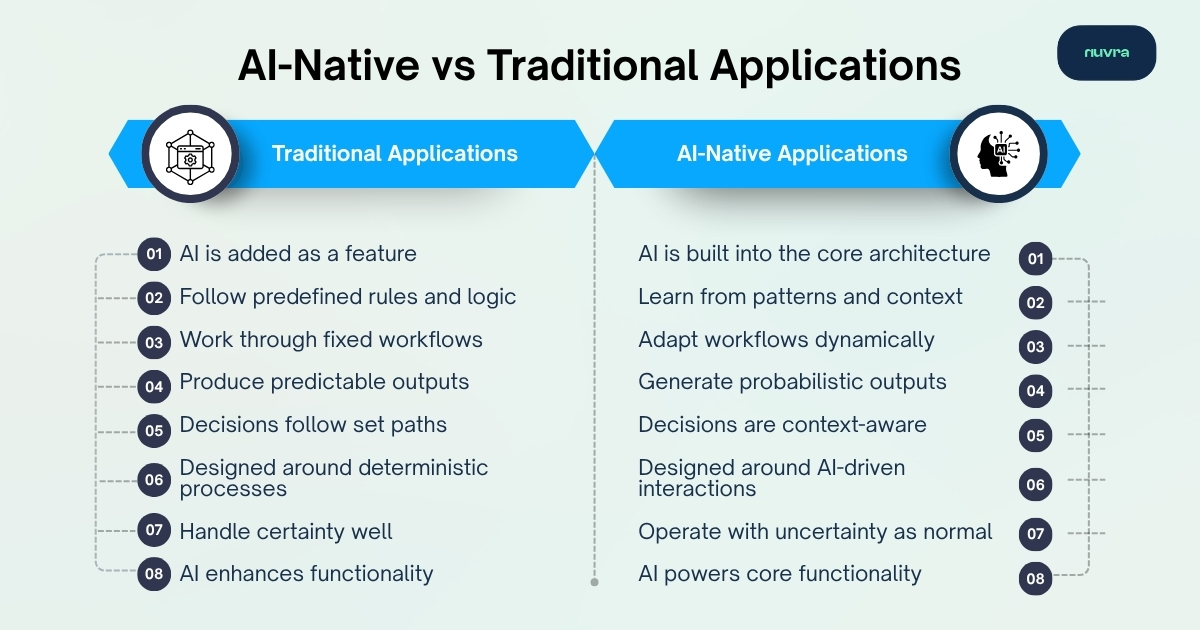
The biggest difference between an AI native application and traditional software is design intent. Traditional systems typically add AI as a feature layer on top of deterministic workflows. AI-native systems, however, are architected so that intelligent behaviour is central to how the product operates.
This distinction becomes particularly important in production. Traditional applications often assume predictable outputs and predefined decision paths. An AI native application, however, must account for probabilistic outputs, model behaviour changes, and retrieval quality variations as core operational concerns.
Why Design Intent Matters
Because AI sits at the center of the architecture, supporting systems must also be designed differently. Data pipelines, feedback loops, evaluation frameworks, and failure handling mechanisms all need to be built with AI behaviour in mind rather than retrofitted later.
The goal is not to eliminate uncertainty but to build systems that can operate reliably despite it. This mindset influences every architectural decision that follows.
Key Architectural Components of an AI-Native Application
Data Freshness and Context Boundaries
Many teams assume better prompts will solve poor outputs. In reality, context quality often matters far more than prompt quality.
An AI native application depends heavily on access to relevant, accurate, and timely information. If the model operates on stale, incomplete, or poorly scoped data, output quality will suffer regardless of how well the prompt is structured. Designing clear context boundaries and keeping data pipelines fresh is therefore a foundational architectural requirement.
Observability Beyond Traditional Monitoring
Traditional observability focuses on infrastructure health through metrics such as latency, uptime, and resource utilization. AI systems require an additional layer of observability focused on output quality, retrieval effectiveness, and model behavior over time.
Key components of AI observability include:
- Output quality tracking
- Retrieval accuracy monitoring
- User feedback collection
- Hallucination detection
- Model drift evaluation
Without evaluation pipelines, teams have no reliable way to determine whether changes improve or degrade system performance over time. Monitoring dashboards can tell you if a service is running. Evaluation pipelines tell you if it is actually working.
When to Use Vector Databases, Retrieval Systems, and AI Agents
When Retrieval Systems Are Necessary
Retrieval systems become valuable when output quality depends directly on accessing large volumes of changing information. In these scenarios, keyword search often struggles to identify relevant content, and static context windows become insufficient to support reliable outputs across diverse queries.
When Vector Databases Are Necessary
Vector databases are most effective when semantic similarity matters more than exact keyword matching. They enable AI systems to retrieve information based on meaning rather than literal text matches, which is particularly important for knowledge-intensive applications where user queries are varied and unpredictable.
That said, many teams introduce vector databases long before they are necessary. If traditional search adequately solves the problem, adding retrieval infrastructure simply increases complexity without improving output quality. The decision should be driven by actual retrieval limitations, not architectural trends.
When AI Agents Are Necessary
AI agents are useful when systems must make decisions across multiple steps while responding to changing conditions. Examples include coordinating workflows, interacting with external tools, or managing dynamic tasks that cannot be resolved through a single model call.
However, agents should not be treated as a default architectural choice. Like vector databases, they are frequently deployed because they sound advanced rather than because the problem genuinely requires multi-step autonomous decision-making. Unnecessary agent complexity creates orchestration overhead and makes failure modes significantly harder to debug.
Common Mistakes When Building an AI-Native Application
Treating the Model as the Product
One of the most common mistakes teams make is focusing almost entirely on model selection while neglecting the surrounding experience.
Users rarely judge products based solely on model quality. They evaluate reliability, speed, usability, and consistency. An exceptional model operating inside a poorly designed system often performs worse in production than a simpler model embedded within a well-architected, reliable platform.
Skipping Evaluation Frameworks
Many early-stage teams launch AI features without defining what successful output actually looks like.
Without evaluation criteria, there is no baseline against which improvements can be measured. This makes it difficult to identify regressions, compare models, or assess whether changes are genuinely benefiting the product or introducing subtle degradation.
Adding Components for Prestige
Another common issue is introducing technologies simply because they are associated with modern AI architectures. Common examples include:
- Unnecessary vector databases
- Over-engineered agent frameworks
- Complex orchestration layers
- Retrieval systems solving non-existent problems
How to Design Reliable and Scalable AI Systems
Deterministic Guardrails for Non-Deterministic Systems
AI outputs may be unpredictable, but the systems surrounding them should not be.
Effective guardrails often include confidence thresholds, output validation, fallback workflows, and clearly defined response boundaries. These mechanisms help maintain reliability even when model behaviour varies, ensuring the broader system continues operating predictably under production conditions.
Designing Infrastructure for Elastic AI Workloads
Unlike traditional workloads, AI inference traffic is often highly variable. Demand spikes, latency sensitivity, and model execution costs create unique scaling challenges.
As a result, infrastructure should be designed with elasticity in mind from the beginning. Asynchronous processing, workload isolation, and dynamic resource allocation help accommodate changing demand patterns without over-provisioning static infrastructure.
Why Self-Healing Infrastructure Matters
Production AI systems cannot rely entirely on manual intervention when failures occur. Reliability depends on implementing safeguards such as confidence thresholds, output validation, fallback workflows, and automated recovery mechanisms that allow systems to maintain continuity without human intervention at every failure point.
Building a successful AI native application requires more than selecting the right model. Long-term success depends on thoughtful architecture, reliable retrieval systems, strong evaluation practices, and infrastructure that supports sustainable scaling. Businesses building AI-native products can benefit from working with experienced partners like Nuvra.